

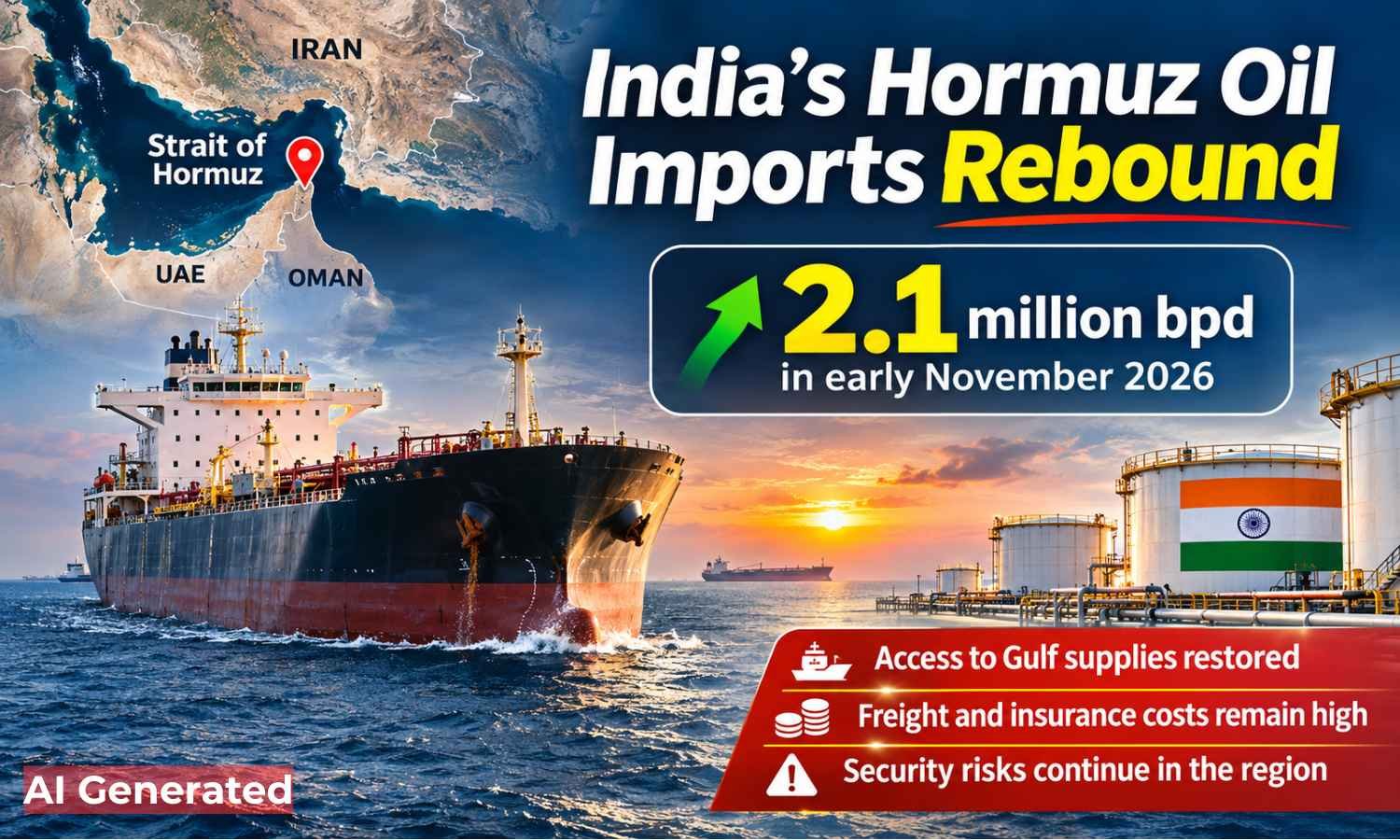
Hyderabad: India’s crude oil imports through Hormuz-linked routes recovered sharply in early November 2026, reaching approximately 2.1 million barrels per day. The rebound has restored access to important Gulf supplies after months of severe shipping disruptions. However, continuing tanker attacks, higher freight charges and war-risk insurance costs are keeping India’s energy import expenses elevated.
The recovery comes nearly nine months after major disruptions began in the Strait of Hormuz amid the conflict involving the United States, Israel and Iran. Although the waterway remains operational, shipping continues under selective restrictions and heightened security risks. Tanker movements have recovered during certain periods, but overall traffic remains well below pre-conflict levels.
The Strait of Hormuz carried approximately one-fifth of global seaborne oil trade before the crisis began in late February 2026. Since then, restrictions and maritime security incidents have forced exporters and shipping companies to change established supply routes. The resulting uncertainty has affected crude prices, transportation costs and energy security across major importing economies.
Despite the restrictions, oil shipments have continued through several alternative arrangements. These include escorted tanker movements, ship-to-ship transfers, loadings in the Gulf of Oman and pipeline routes that bypass the strait. However, these measures have not fully restored normal shipping conditions or eliminated the risks facing commercial vessels.
Recent incidents have added to concerns about the safety of oil shipments. Reports around Thursday (November 12) described multiple tankers disabled or on fire after suspected mine contacts or attacks. The incidents reportedly contributed to oil spills and renewed uncertainty over shipping operations. Iranian authorities have repeatedly claimed that tankers using routes they consider unauthorised have encountered mines or explosions.
Meanwhile, UK maritime monitoring agencies have recorded projectile strikes and other incidents affecting vessels in the region. These developments have sustained pressure on shipping companies and insurers despite the partial recovery in traffic. War-risk insurance premiums and tanker freight rates have consequently remained substantially above normal levels.
During periods of heightened disruption, freight rates for very large crude carriers operating between the Middle East Gulf and China have approached $24 per barrel. Such charges increase the delivered cost of crude oil, even when international benchmark prices decline. The additional expenses have become a significant concern for countries heavily dependent on imported energy.
Global crude prices have also responded to the changing security situation. Brent crude has recently traded in the low-to-mid $90s per barrel, compared with approximately $72 before the crisis. This represents an increase of roughly 25–30 percent from immediate pre-conflict levels.
Nevertheless, Brent prices remain well below the peaks exceeding $120 per barrel recorded earlier in 2026. Prices have fluctuated with each fresh shipping incident and indications of possible diplomatic de-escalation. Additional supplies from producers outside the Middle East have helped limit further increases. Changes in demand and available inventories have also prevented a sustained return to triple-digit prices.
India remains particularly exposed because it is the world’s third-largest crude oil importer. The country depends on overseas supplies for approximately 85–90 percent of its crude requirements. Before the conflict, substantial volumes reached Indian refineries through Hormuz from Saudi Arabia, the United Arab Emirates, Iraq and Kuwait.
Average crude shipments through the strait to Indian refiners stood near 2.8 million barrels per day before the disruptions. However, deliveries collapsed to approximately 247,000 barrels per day in April 2026 during the most severe phase. The sharp decline forced Indian refiners to rely more heavily on alternative suppliers and shipping arrangements.
Russia helped bridge much of the supply gap and remained India’s largest crude supplier for extended periods. By early November, however, the import pattern had changed considerably. Tracking data showed Hormuz-linked crude deliveries recovering to around 2.1 million barrels per day. These shipments surpassed Russian imports, estimated at approximately 1.8 million barrels per day, for the first time since the conflict intensified.
The rebound reflected improved tanker movements, competitive pricing from Gulf producers and changes in crude transportation arrangements. Ship-to-ship transfers also helped maintain supplies despite congestion and security risks near the strait. Some transfer operations shifted closer to Indian waters as shipping companies adjusted their routes.
Major Gulf exporters have reported combined shipment volumes approaching earlier levels during recent months. At the same time, higher freight charges on longer Russian routes have reduced the relative attractiveness of some Russian crude shipments. Consequently, Indian refiners have found certain Gulf supplies more competitive despite continuing regional security concerns.
Higher freight costs pressure India’s energy imports and economy
The recovery in Gulf supplies has improved crude availability, but higher shipping costs continue to affect India’s import bill. Freight expenses on important Gulf-to-India routes have reportedly increased nearly fivefold in some cases. These increases raise the final cost of delivered crude, even during periods of softer international oil prices.
India’s crude import bill has climbed sharply on a year-on-year basis during the current fiscal year. Higher benchmark prices earlier in the conflict contributed to the increase, alongside elevated freight and insurance expenses. As a result, improved access to Gulf oil has not translated into a comparable reduction in overall procurement costs.
The disruption also presents risks for India’s liquefied natural gas imports. Significant LNG supplies from Qatar and the United Arab Emirates have traditionally moved through the Strait of Hormuz. Restrictions affecting these shipments can create additional pressure on energy procurement and transportation costs. India has responded by increasing diversification toward other gas suppliers.
Higher energy import expenses can affect several parts of the Indian economy. Increased spending on crude oil and gas places pressure on the current account and raises foreign exchange requirements. These costs can also contribute to inflation through fuel, transportation and fertiliser prices.
Persistent energy-related inflation can weaken consumer spending and increase operating expenses across economic sectors. It may also weigh on growth and place additional pressure on the rupee. However, recent declines in international crude prices have provided some relief. Softer prices have also supported currency stability, although uncertainty over future shipping disruptions remains.
India’s strategic petroleum reserves offer another measure of protection against temporary supply interruptions. However, available emergency reserves provide a limited buffer, measured in days to weeks of cover. A prolonged disruption to major shipping corridors could therefore create fresh supply and pricing challenges.
Indian officials have repeatedly called for free and safe navigation through the Strait of Hormuz. The government has also engaged with concerned parties while emphasising the importance of protecting international shipping. It has condemned attacks on civilian vessels and seafarers, including incidents involving Indian nationals.
Naval measures to protect energy shipments have formed part of India’s response to the maritime security situation. At the diplomatic level, the country has maintained an approach that emphasises dialogue and engagement with the parties involved. These efforts reflect the need to protect energy supplies while avoiding further regional instability.
The prolonged crisis has also reinforced the importance of reducing dependence on a limited number of suppliers and maritime corridors. Expanding crude sourcing options and developing alternative transportation routes could strengthen India’s ability to manage future disruptions. Greater strategic storage capacity would provide additional protection against sudden interruptions.
Other longer-term priorities include increasing domestic energy production and expanding renewable energy capacity. Strengthening India’s shipping capabilities could also improve flexibility during periods of international maritime disruption. Together, these measures could help reduce exposure to supply shocks and volatile transportation costs.
For now, the recovery in Hormuz oil flows has eased some of the immediate pressure on Indian refiners. Diversification toward Russia and other suppliers has also helped India manage the disruption. Nevertheless, higher freight charges and continuing tanker security risks remain major concerns.
Any sharp escalation in the regional conflict could reverse recent improvements in Gulf oil deliveries. Further attacks on commercial vessels could also increase insurance premiums and push crude prices higher. Until maritime conditions stabilise, the Strait of Hormuz will remain a major source of uncertainty for global energy markets and India.
