

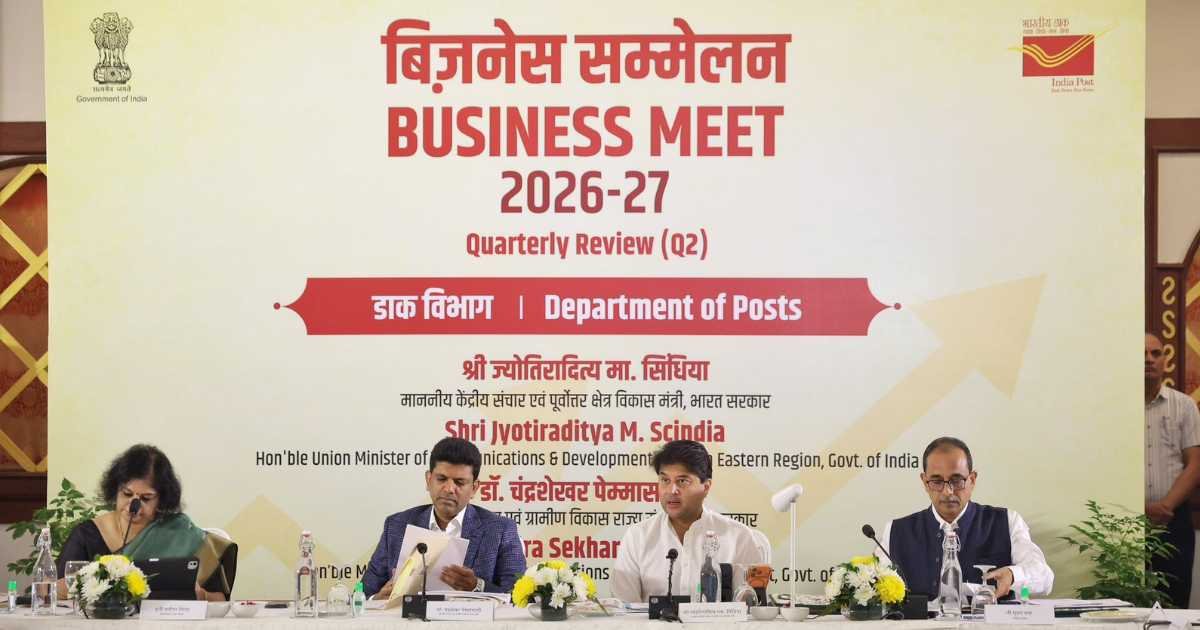
New Delhi: India Post recorded strong postal revenue growth, earning ₹8,212.7 crore in the first half of FY 2026-27. Revenue rose 24% year-on-year from ₹6,636 crore in April-September 2025. For the first time, the Department of Posts crossed ₹4,000 crore in quarterly revenue for two consecutive quarters.
The department earned ₹4,201.5 crore in the July-September quarter. This marked 25% growth year-on-year and a 5% increase over the first quarter. Union Communications Minister Jyotiraditya M. Scindia reviewed the performance at a meeting in New Delhi on October 22.
Union Minister of State for Communications and Rural Development Chandra Sekhar Pemmasani attended the meeting. Secretary (Posts) Subrat Das, Postal Services Board members, Chief Postmasters General and senior departmental officers also participated.
All six business verticals recorded year-on-year growth during the first half. Premium and Rural Postal Life Insurance (PLI/RPLI) grew by 44%, while Mails revenue increased by 36%. International Relations and Global Business registered 38% growth, and the Parcels vertical recorded the highest increase at 71%. Meanwhile, the Post Office Savings Bank business grew by 18%.
The Parcels vertical generated ₹318.9 crore in the second quarter. Kerala, the North East, Uttar Pradesh and Bihar exceeded their quarterly targets. Mails revenue also rose 26% over the first quarter, with 12 Postal Circles meeting or surpassing their second-quarter targets. The Post Office Savings Bank contributed ₹1,987 crore, while PLI/RPLI achieved 92% of its quarterly target.
Postal revenue growth reflects stronger circle performance
Seven Postal Circles achieved at least 90% of their proportionate second-quarter targets. Bihar led with 97.15%, followed by West Bengal at 97.07% and the North East at 94.79%. For the first half, West Bengal achieved 95.72% of its target, followed by Bihar at 95.12% and Andhra Pradesh at 94.63%.
Moreover, 18 of the 23 Postal Circles improved their target achievement over the first quarter. The expenditure-cost ratio stood at 42% when pension expenditure was included and 62% when it was excluded. In addition, 22 Circles improved their ratios compared with the previous quarter.
The department recognised Andhra Pradesh Postal Circle for its performance in the first quarter, from April to June 2026. Bihar Postal Circle received recognition for the second quarter, from July to September. The awards acknowledged their performance against proportionate business targets and efforts to strengthen revenue generation.
Scindia congratulated postal officers and employees on the results. He stressed customer acquisition, service quality and customer retention as priorities for sustaining growth. He also called for business diversification, stronger leadership and innovation. Furthermore, he urged the department to consider flexible pricing for bulk customers, subject to applicable policies and approvals.
Scindia also emphasised faster digitalisation of India Post services. These improvements, he said, would enhance customer experience, operational efficiency and competitiveness. Pemmasani highlighted the department’s growth potential and called for workforce empowerment, accountability and better service delivery.
Pemmasani also stressed standardised procedures and real-time monitoring to address parcel delivery delays. Both ministers directed Postal Circles to maintain growth during the festive period and peak parcel season. They also called for stronger parcel and international business operations, faster onboarding of citizen-centric services with state governments, and continued expenditure discipline.
The review further emphasised a cluster-based strategy covering agro-logistics and international business; MSMEs, One District One Product initiatives and tourism; and citizen-centric services, financial inclusion, insurance and rural logistics. Through its extensive network and workforce, the department aims to develop new business opportunities, improve operational efficiency and move towards financial sustainability.
A historic Q2 for @IndiaPostOffice, after a historic Q1.
Growth momentum continues, with Q2 revenue at ₹4,202 crore, up 25% year on year, led by:
Parcel: +71%
PLI/RPLI: +44%
IR & GB: +38%Chaired the Quarterly Business Review with all 23 circles, where 19 crossed 80% of their Q2 targets. Reaffirmed our commitment to working as one India Post family, with greater synergy and a unified focus on scaling up and serving our customers to the best of our ability.
#DakSewaJanSewa
— Jyotiraditya M. Scindia (@JM_Scindia) October 22, 2026
