

New Delhi: Indian researchers discovered a rare compact stellar pair that could improve scientific understanding of star evolution and binary systems. The discovery confirmed a blue straggler system hosting a brown dwarf companion in one of the shortest-period stellar binaries identified so far.
Scientists from Gauhati University, the Indian Institute of Astrophysics, ARIES Nainital and Italy’s INAF-Catania Observatory conducted the study with support from the Department of Science and Technology under the INSPIRE programme.
The researchers found that the binary system completed one orbit in nearly 5.6 hours. They also identified the lightest companion detected around a blue straggler star. The companion carried only 0.056 times the Sun’s mass, placing it below the hydrogen-burning limit.
Blue straggler stars have puzzled astronomers for decades because they appear brighter and younger than other stars in the same cluster. Scientists generally expect stars in a cluster to share a similar age and evolutionary stage.
The research team included Ali Hasan Sheikh, Prof. Biman J. Medhi, Dr. Sergio Messina, Prof. Annapurni Subramanium, Prof. Ram Sagar and Dr. Neelam Panwar.
Study reveals formation of blue straggler system
The study, published in the journal Monthly Notices of the Royal Astronomical Society: Letters, identified the shortest-period binary located within the “brown dwarf desert.” Scientists consider this region unusual because brown dwarf companions rarely exist in such close stellar systems.
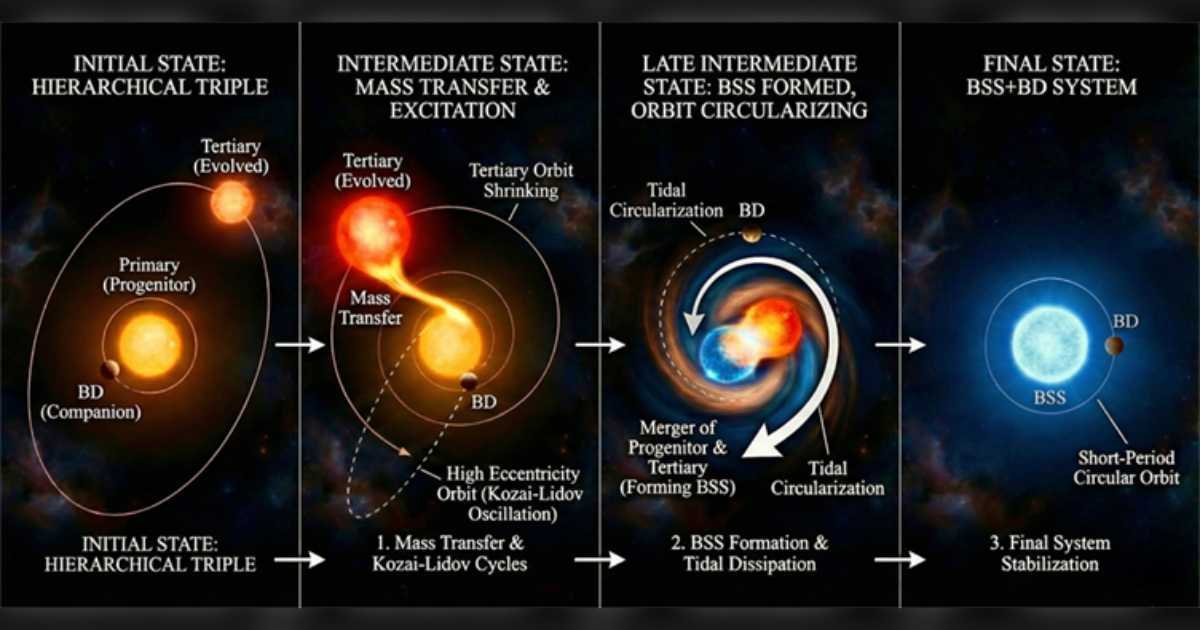
Researchers explained that the system likely evolved through interactions in a triple-star arrangement. According to the proposed model, mass transfer and orbital interactions caused two stars to merge and form the blue straggler star. Later, tidal forces stabilised the orbit into the compact structure observed today.
Scientists said the findings would help refine models related to stellar evolution, binary interactions and substellar objects. In addition, the study demonstrated how archival astronomical data could produce major discoveries without requiring expensive new facilities.
The researchers stated that the findings could improve interpretation of observations from ground-based telescopes and future space missions studying stellar systems and cosmic evolution.
