
Siraj’s omission turns a cricketing decision into a political debate

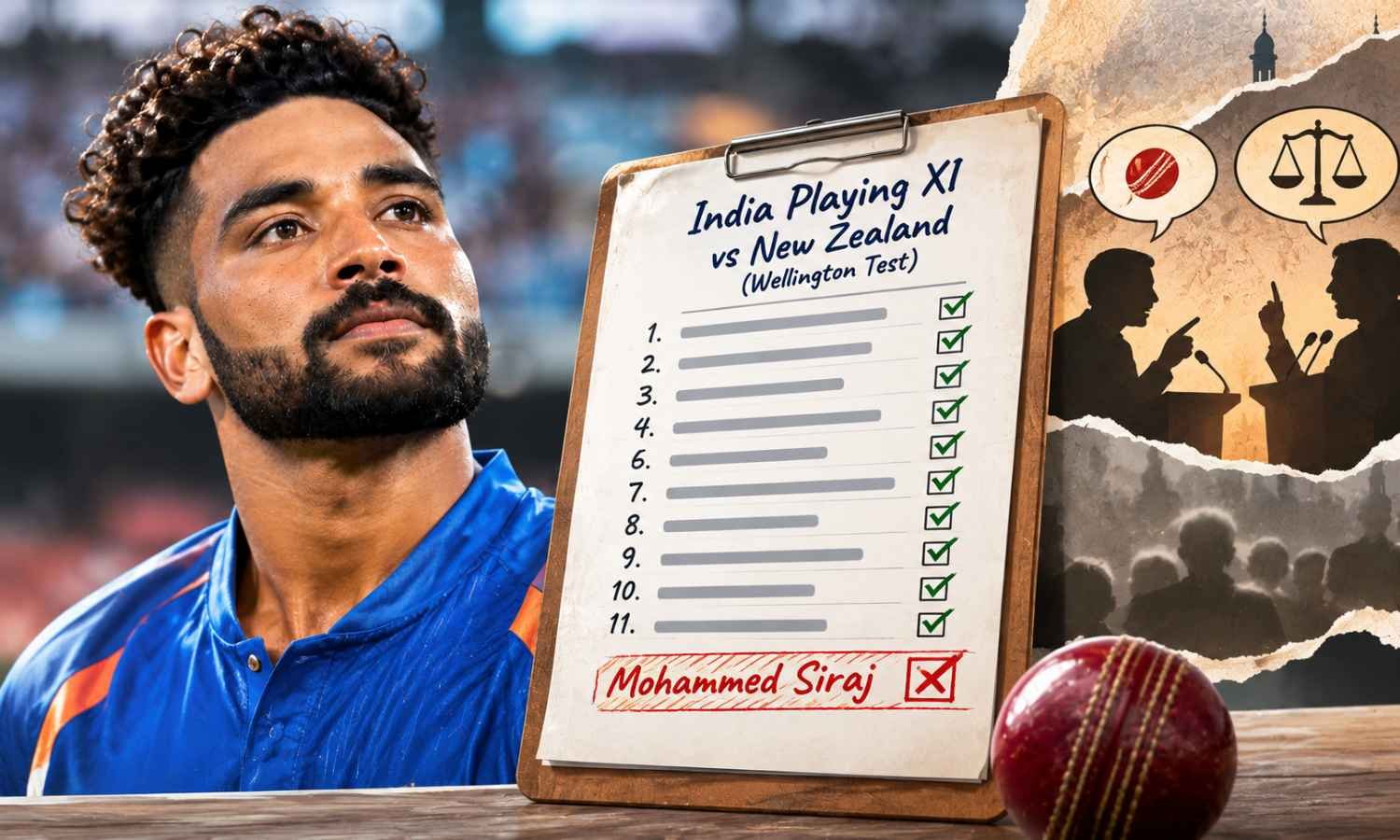
Wellington: Mohammed Siraj was not among the eleven Indian players who took the field against New Zealand at the Basin Reserve on November 19. Yet his absence quickly became one of the major talking points surrounding the Test, generating questions that extended far beyond India’s bowling combination.
The decision to leave out an experienced fast bowler with a substantial overseas record was always likely to attract scrutiny. What made the controversy unusual was the subsequent attempt to interpret the selection through the prism of religious identity, turning a tactical decision into a political argument.
India chose Jasprit Bumrah, Prasidh Krishna, Akash Deep and Anshul Kamboj as its specialist fast bowlers, while Washington Sundar was preferred as the spin-bowling option. Siraj and Ravindra Jadeja were excluded from the playing XI despite their considerable international experience.
The selection came against the background of Siraj’s strong performance in the 2025 Test series in England, where he claimed 23 wickets and played a decisive role in India’s victory at The Oval. Those performances reinforced his reputation as a dependable bowler capable of delivering long spells in demanding overseas conditions.
His recent record, however, also presented questions about form and rhythm. A reduced wicket-taking return in subsequent appearances created a basis for the team management to reconsider the balance of its attack, particularly when several pace-bowling options were available.
Selection involves more than reputation
A Test playing XI is rarely chosen on career statistics alone. Pitch conditions, expected weather, workload, current form, bowling variety and the batting contribution of individual players can all influence the final combination.
Wellington’s conditions encouraged the selection of a pace-heavy attack. The management opted for bowlers offering different combinations of movement, pace and control, while also considering the need to maintain balance across five days.
That explanation does not automatically settle the debate. Siraj’s experience in England, Australia and South Africa provides a legitimate basis for questioning whether the chosen attack represented India’s strongest available combination. Equally, his past achievements do not guarantee selection irrespective of immediate tactical requirements.
The difficulty lies in assessing a decision whose underlying calculations are not completely visible to the public. Supporters can examine bowling figures, playing conditions and recent performances, but they cannot fully know the internal discussions that led to the final selection.
This uncertainty is common in international cricket. The same decision can appear reasonable to selectors prioritising a particular combination and questionable to observers placing greater weight on experience.
When identity enters the selection argument
The controversy acquired a different character when Congress MP Imran Masood suggested that Siraj’s exclusion was connected to his name and religious identity. The suggestion drew criticism from BJP leaders and introduced a communal dimension into what had initially been a cricketing dispute.
There is no established evidence that Siraj was excluded because of his religion. The simultaneous omission of Jadeja also demonstrates that the management made more than one significant selection decision for the match.
Questioning a selection is an ordinary part of sporting debate. Alleging discrimination is a more serious matter that requires evidence capable of distinguishing prejudice from legitimate, even if disputable, sporting judgement.
The distinction matters for players as well as administrators. Once a selection controversy is framed around identity, subsequent decisions may be interpreted through political expectations rather than cricketing considerations. This can obscure legitimate questions about performance, fitness, communication and the overall composition of the team.
Siraj’s next opportunity remains the real test
Siraj’s exclusion from one Test does not, by itself, establish a permanent change in his standing. He remains an experienced international bowler whose record demonstrates his ability to perform in difficult conditions.
The longer-term significance will depend on subsequent selections, opportunities and performances. Consistent standards and clear communication from the management can help prevent avoidable uncertainty, particularly when established players are left out.
Indian cricket has witnessed numerous controversial selections involving senior players. The latest episode illustrates how quickly an ordinary sporting disagreement can become entangled with political identities.
Siraj’s contribution to Indian cricket ultimately rests on his performances and his ability to influence matches. The decision in Wellington can be debated on cricketing grounds without making unsupported assumptions about the motives of those responsible for selecting the team.
