
Thank you, Youth Congress, for introducing a new Meta appeal process
By Shaik Ahmed Ali

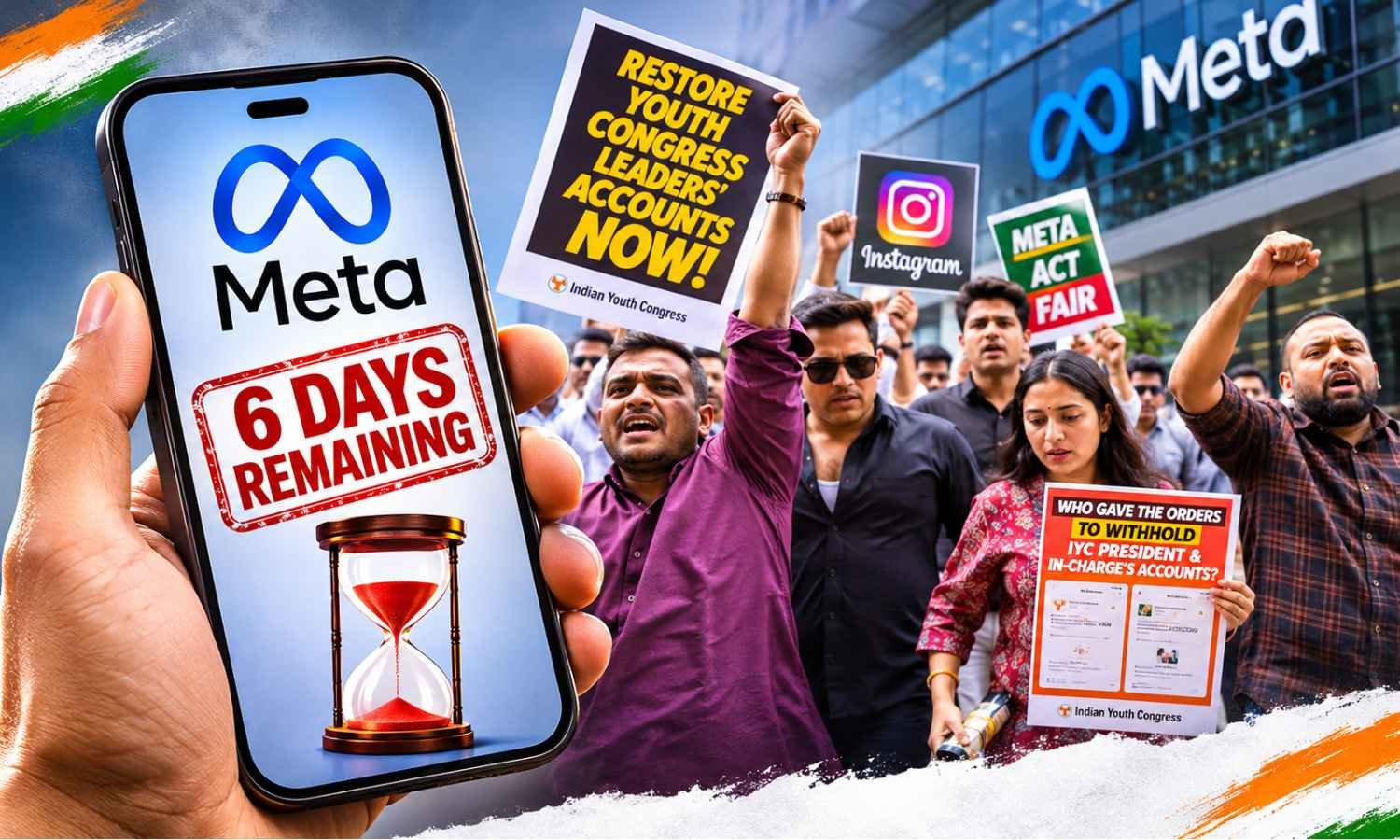
Hyderabad: For years, people whose social media accounts were restricted or suspended have been expected to follow a familiar procedure. They submit an online appeal, explain their grievance and hope that someone at the other end of the system reviews their complaint. The Youth Congress has now demonstrated that the digital age can accommodate a distinctly old-fashioned alternative: turning up at the company’s office.
The idea was put into practice on November 20, when Youth Congress workers protested at premises associated with Meta in Hyderabad, Mumbai and Gurugram. Their immediate grievance concerned restrictions on Instagram accounts belonging to senior leaders of the organisation.
The protests brought a dispute usually handled through digital channels into the physical spaces occupied by one of the world’s largest technology companies. In Hyderabad, the demonstration also involved damage to property and police intervention, adding an unwelcome dimension to what had begun as a controversy over online access.
The Youth Congress subsequently claimed that accounts belonging to its leaders were restored shortly after the demonstrations. The timing was presented as an indication of the effectiveness of the protest, although an independently established causal connection between the demonstrations and the restoration has not emerged.
An appeal process with a difference
Meta has established procedures for challenging decisions concerning account restrictions, content removal and access to its services. Users ordinarily navigate these mechanisms through online forms, notifications and account-review systems, often without direct access to the individuals responsible for the decisions.
For political organisations accustomed to public demonstrations, however, the absence of a physical grievance counter need not be an insurmountable obstacle. If the platform does not offer a convenient place for face-to-face complaints, its office premises can apparently become the next destination.
The innovation is unlikely to feature in any official user-support manual. It requires neither a new software feature nor a revised complaints policy. It simply transfers the frustration of a suspended account from the screen of a mobile phone to the entrance of a corporate workplace.
The difficulty, of course, is that offices are not public grievance centres and employees are not responsible for personally resolving every account dispute. Protests that disrupt operations or involve damage to property create concerns substantially different from those arising from ordinary complaints.
The Hyderabad episode therefore cannot reasonably be treated as evidence that physical confrontation is an acceptable or effective replacement for established procedures.
A precedent with uncomfortable implications
The deeper irony lies in the relationship between the enormous scale of online moderation and the limited visibility of the appeal process for individual users.
Major platforms routinely make decisions affecting large numbers of accounts and posts. Their systems must handle genuine violations, automated enforcement, mistaken restrictions and disputes involving political speech. The more consequential these decisions become, the greater the need for transparent and accessible review mechanisms.
Political parties, journalists, activists and ordinary users may disagree strongly with decisions affecting their accounts. They also have legitimate reasons to demand clarity about applicable rules and opportunities for appeal.
But consider the practical consequences if visiting a corporate office were to become the preferred response to a suspension. Every disputed account could become a potential demonstration. Every moderation decision could require not merely a technical review but an assessment of the likelihood of a crowd assembling outside the company’s premises.
That would be a remarkable transformation of customer support, though probably not the innovation Hyderabad’s technology industry had in mind.
Digital grievances need digital accountability
The episode has also exposed a more serious issue beneath the political theatre. Platforms exercising substantial influence over public communication need credible mechanisms for explaining and reviewing decisions, particularly when political expression is involved.
Improving those mechanisms would serve users across political affiliations. It would also reduce the temptation to treat account moderation as a contest of organisational strength rather than an issue governed by clearly stated policies.
For now, the Youth Congress has added an unexpected chapter to the discussion on digital grievance redressal. Whether its claimed account restorations resulted from the demonstrations, existing appeals or other decisions remains uncertain.
Meta may continue recommending online appeals. The Youth Congress has nevertheless ensured that the next discussion about grievance procedures will include a question that once seemed unnecessary: must every digital complaint now come with directions to the nearest corporate office?
