

Vijaywada: The first National SARAS Mela held outside Delhi-NCR concluded in Vijayawada with sales exceeding ₹12.8 crore and more than 12 lakh visitors. The event brought together around 1,500 rural women entrepreneurs from Self-Help Groups (SHGs) and Lakhpati Didis across more than 30 States and Union Territories. Organised by the Union Ministry of Rural Development with the Andhra Pradesh government, the mela featured 600 stalls at Punnami Ghat.
The exhibition attracted an average of 45,000 to 50,000 visitors daily. President Droupadi Murmu inaugurated the event on October 15, 2026, and interacted with Lakhpati Didis. She noted the rise in women’s entrepreneurship and their growing role in rural economic decision-making.
The event received support from the National Institute of Rural Development and Panchayati Raj (NIRDPR) and Kudumbashree. Andhra Pradesh Governor S. Abdul Nazeer, Chief Minister N. Chandrababu Naidu and Union Ministers Shivraj Singh Chouhan, K. Rammohan Naidu and Pemmasani Chandra Sekhar also attended. In addition, Madhya Pradesh Chief Minister Mohan Yadav and Chinese Ambassador Xu Feihong visited stalls and interacted with entrepreneurs.
The SARAS Mela provided a national marketplace for rural women to display handloom, handicrafts, natural food products and regional cuisine. It also advanced the Prime Minister’s Vocal for Local call and the target of creating six crore Lakhpati Didis by 2029. Under the Deendayal Antyodaya Yojana–National Rural Livelihoods Mission, the government supports SHG women through skills, financial assistance, market access and entrepreneurship opportunities.
Union Rural Development Minister Shivraj Singh Chouhan said the Centre and Andhra Pradesh were working to strengthen women’s financial independence through technology and improved marketing. He also said the State’s initiatives, including SHE Marts and the Swayam Andhra brand, could be expanded across the country.
Chief Minister Chandrababu Naidu urged women to become job creators rather than only seek employment. He said the mela should lead to year-round market opportunities for products made by rural women. Meanwhile, the exhibition’s sales figures highlighted strong demand for traditional products.
SARAS Mela sales led by handloom and handicrafts
Handloom and handicrafts together accounted for 75% of the total sales. The SARAS Shakti Food Court, which operated 50 stalls, generated more than ₹1.9 crore. Its stalls were run by over 200 women entrepreneurs from more than 30 States and Union Territories. The highest-grossing stall recorded sales of ₹15.6 lakh.
Cyclone Arnab affected Vijayawada during the final days and forced a temporary closure on October 28 and 29. However, the State administration and organisers maintained safety and operations despite the weather and transport disruptions. The event ultimately recorded more than 12 lakh visitors.
The mela also helped women understand pricing, product quality, packaging and consumer preferences. It featured 10 Farmer Producer Organisations and 15 Cluster-Level Federations. A dedicated Lakhpati Didi Pavilion presented 21 women entrepreneurs and their business journeys. Among them, 11 women reported annual turnovers between ₹50 lakh and ₹1 crore. Lakhpati Didis are SHG members whose households earn a sustainable annual income of at least ₹1 lakh.
Two entrepreneurs highlighted the opportunities available to rural women. Chandrakala of Lotus SHG in Tirupati took charge of her family’s woodcarving business in 2007 after her husband’s death. Her enterprise now reports an annual turnover exceeding ₹1 crore. Similarly, Siddhi of Mahamaya SHG in North Goa expanded her ethnic wear business through Instagram and received overseas orders. Her annual turnover has crossed ₹60 lakh.
The Learning and Knowledge Pavilion hosted more than 50 training sessions for women entrepreneurs. Representatives from institutions and companies offered guidance on enterprise development, finance and digital tools. NIRDPR covered branding, product design, packaging and export marketing, while NABARD focused on business expansion through finance. UNICEF introduced digital courses on using artificial intelligence to start and manage small enterprises. It also used examples such as Computer Didi and Didi ki Dukan to explain digital tools and financial literacy.
Additionally, 10 structured buyer-seller meetings connected entrepreneurs with corporate procurement and retail channels. Participating delegations included Fabindia and My e-Haat of the HCL Foundation. These meetings aimed to create business relationships beyond the exhibition.
The Convergence Pavilion brought together 20 Central and State government departments, including those handling MSME, textiles, agriculture and tribal affairs. The facility helped entrepreneurs access formal credit, Udyam registration and statutory certifications. Digital facilitation desks also supported online transactions and market access through GeM, Flipkart Samarth and Meesho. Organisers reported 100% UPI adoption at the event.
The SARAS Shakti Food Court showcased regional food traditions through its 50 stalls. An AI-powered customer assistant allowed visitors to scan menus, receive dish recommendations and view customer reviews. Meanwhile, cultural programmes featuring more than 10 States, including Ladakh, Andhra Pradesh, Punjab, Goa, Odisha and Chhattisgarh, presented regional music and performance traditions.
The Society for Elimination of Rural Poverty (SERP), Andhra Pradesh, also organised an Entrepreneurship Development and Acceleration Programme with India SME Forum as the nodal agency. The programme covered expert sessions, product readiness, digital onboarding, pitching, Udyam registration and buyer engagement. It recorded 3,489 attendances at expert sessions and 138 live product pitches. In addition, 288 entrepreneurs received photography and packaging support, while 452 sellers received help with Meesho onboarding.
The programme also enabled 3,383 new WhatsApp Business accounts with product catalogues. Furthermore, the SWAYAM Helpdesk facilitated 15,231 Udyam registrations. These initiatives aimed to help rural enterprises improve their market presence and reach more customers.
The organisers also introduced measures to reduce single-use plastic. They distributed 2 lakh cloth bags across more than 600 stalls and supplied 2,000 reusable glass or clay bottles to artisans. In addition, 800 eco-friendly bamboo or water-hyacinth dustbins were placed across the venue.
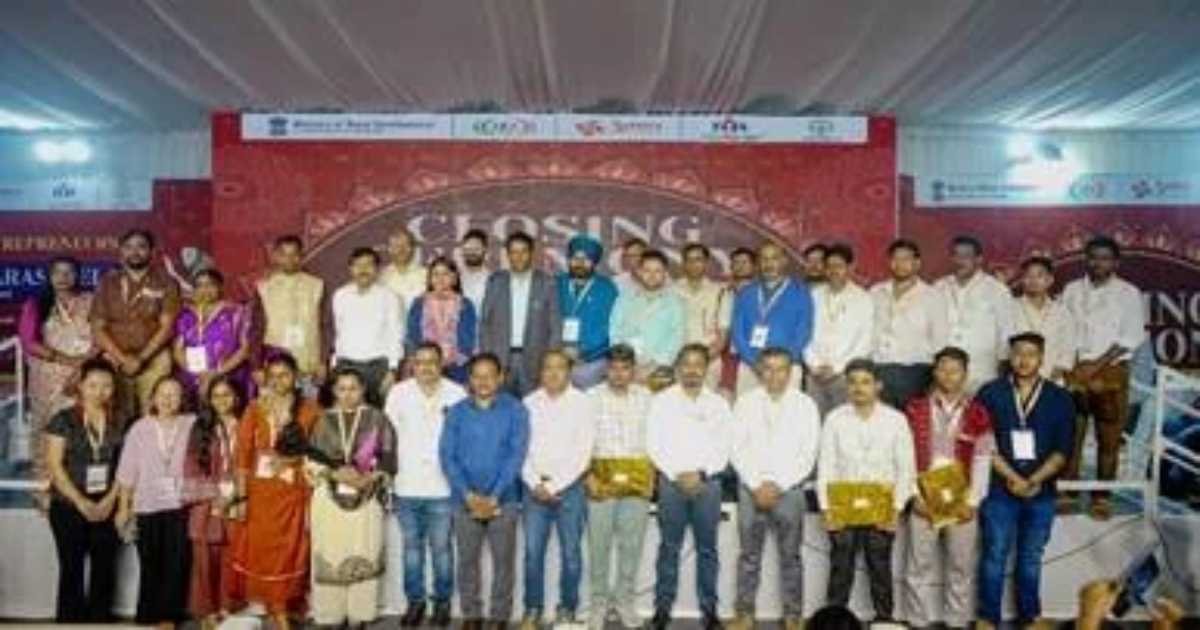
At the closing ceremony, officials presented awards to SHGs in handloom, handicrafts, natural food products and live food categories. They also recognised product quality, packaging, stall design, branding, customer engagement, innovation, demonstrations and social media presence. State nodal officers, district coordinators and teams from the district administration, SERP, NIRDPR and Kudumbashree received awards for supporting the event.
Overall, the SARAS Mela combined sales opportunities with training, institutional support and digital market access. The event gave rural women entrepreneurs wider consumer exposure and helped them explore business opportunities beyond the exhibition.
