

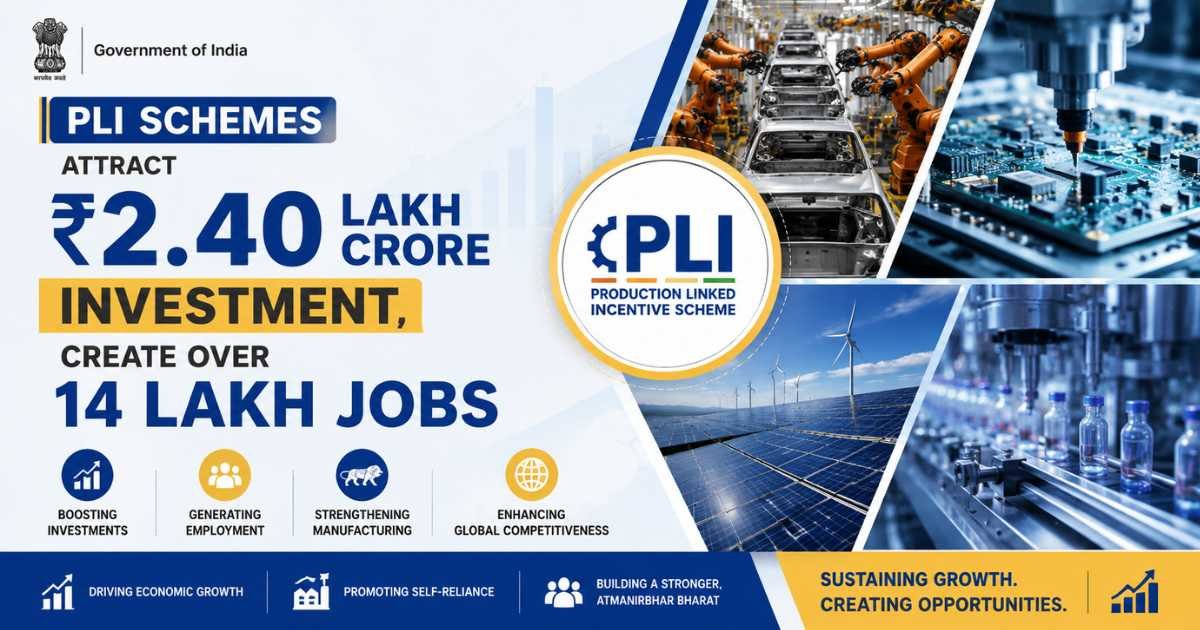
New Delhi: The Government said PLI schemes attracted investments of more than ₹2.40 lakh crore and generated over 14.15 lakh direct and indirect jobs as of March 31, 2026. The schemes also enabled exports worth more than ₹15.2 lakh crore across 14 key manufacturing sectors.
The Production Linked Incentive (PLI) schemes have an approved financial outlay of ₹1.91 lakh crore. They aim to strengthen manufacturing, attract investment, increase exports and improve India’s global competitiveness. Meanwhile, the Department for Promotion of Industry and Internal Trade (DPIIT) continues to coordinate and monitor the programme.
The government said cumulative investment under the PLI schemes reached ₹2,40,138 crore by March 2026. Direct employment stood at 8.49 lakh. In addition, indirect employment of 5.66 lakh was reported in large-scale electronics manufacturing, IT hardware and solar PV modules. Together, total employment crossed 14.15 lakh.
PLI schemes strengthen manufacturing and exports
The government said cumulative exports under the PLI schemes increased from ₹4 lakh crore in FY2023-24 to ₹6.5 lakh crore in FY2024-25. Finally, exports reached ₹15.2 lakh crore in FY2025-26. The growth reflected stronger integration with global value chains.
Moreover, mobile phone production increased about 2.4 times after the electronics manufacturing scheme began. Mobile phone imports declined by nearly 77%. Today, around 99.2% of mobile phones used in India are manufactured domestically.
Furthermore, the pharmaceutical sector recorded cumulative sales of more than ₹3.64 lakh crore. The scheme also enabled domestic production of 1,931 pharmaceutical products. These included 191 bulk drugs manufactured in India for the first time.
Similarly, the bulk drugs scheme created manufacturing capacity of about 55,000 metric tonnes across 26 critical active pharmaceutical ingredients. As a result, import dependence for medicines such as Paracetamol, Levofloxacin and Norfloxacin has reduced.
Meanwhile, the medical devices scheme supported domestic production of CT scanners, MRI systems, Cath Labs and ultrasonography equipment. Twenty-two companies have started operations, while 55 unique medical devices have entered production.
In addition, the telecom and networking products scheme supported indigenous 4G technology and domestic manufacturing of 5G equipment. The white goods scheme also expanded compressor manufacturing capacity from one million units in 2021 to 10 million units in 2025-26. It also improved localisation of key air-conditioner components.
The government said implementation of the schemes is reviewed regularly by the Empowered Group of Secretaries and the concerned ministries. Therefore, several guidelines have been revised to improve implementation, encourage investment, boost exports and strengthen domestic manufacturing ecosystems.
Minister of State for Commerce and Industry Jitin Prasada shared the information in a written reply in the Lok Sabha.
