

New Delhi: Strain-controlled plasmonics has enabled Bengaluru researchers to change how metals interact with light. The breakthrough opens a new path for programmable nanophotonic devices that work with standard semiconductor manufacturing.
Scientists at the Jawaharlal Nehru Centre for Advanced Scientific Research (JNCASR), an autonomous institute under the Department of Science and Technology, achieved the breakthrough. They showed that mechanical strain can directly alter the optical behaviour of metals. As a result, the study challenges the long-standing belief that a metal’s optical properties remain fixed.
The team selected ultrathin titanium nitride (TiN) films for the study. TiN offers gold-like plasmonic behaviour, excellent thermal stability and compatibility with CMOS chip technology.
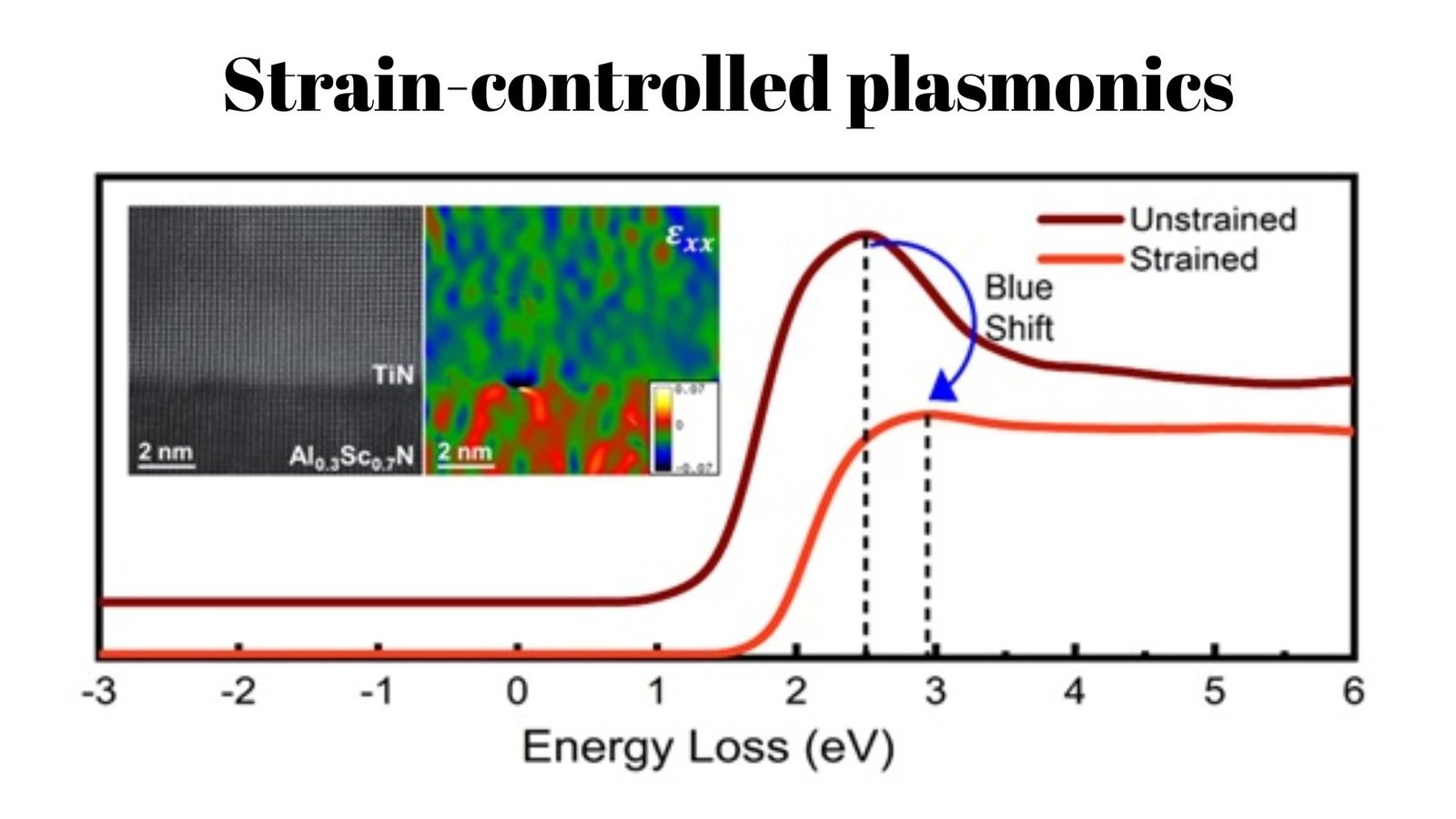
Researchers grew one TiN film on a magnesium oxide substrate without strain. They grew another film on an aluminium scandium nitride buffer layer, which introduced controlled tensile strain.
Strain-controlled plasmonics changes metal-light behaviour
The team measured plasmon resonance with electron energy loss spectroscopy inside a scanning transmission electron microscope. The strained TiN film recorded a blue shift of 0.30 to 0.45 electron volts compared with the unstrained sample.
Next, the researchers performed density functional theory calculations. The calculations showed that tensile strain reduced the energy needed to create nitrogen vacancies. These vacancies increased the free-electron concentration. Consequently, the plasma frequency also increased. The theoretical results matched the experimental observations.
The team also verified the findings through spectroscopic ellipsometry and high-resolution X-ray diffraction.
Associate Professor Prof. Bivas Saha, the corresponding author, said strain offers a powerful way to control plasmonic properties in metals. He added that the discovery transforms plasmonics into an active and programmable platform. Therefore, it could advance optical sensing and on-chip photonics.
Researchers Diksha Dadhich, Dr. Magnus Garbrecht, Vijay Bhatia and Ashalatha Indiradevi Kamalasanan Pillai contributed to the study. The journal Nano Letters published the research.
