

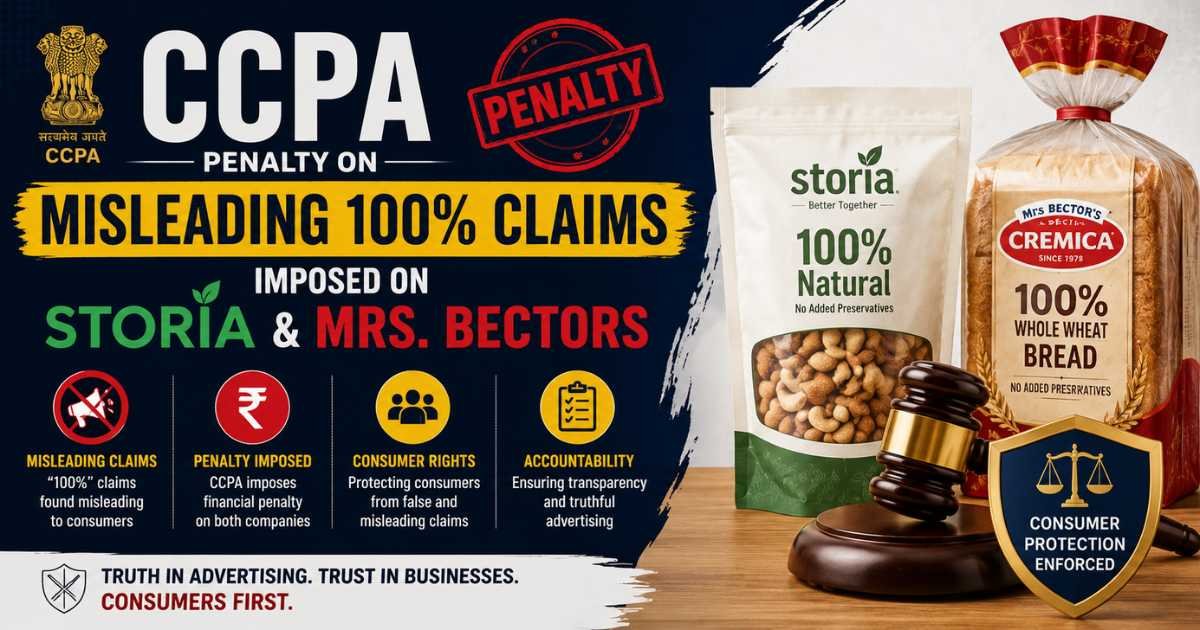
New Delhi: The Central Consumer Protection Authority (CCPA) imposed a penalty of Rs.1 lakh each on Storia Foods and Beverages Private Limited and Mrs. Bectors Food Specialities Limited for misleading consumers through “100%” product claims. The authority also ordered both companies to remove the disputed claims from product packaging, websites and digital platforms.
The action followed findings that the companies used absolute claims that did not accurately reflect the actual composition of their products. The CCPA stated that the expression “100%” is a precise numerical claim and must match the factual content of a product. It said advertisers cannot use the term loosely as a marketing slogan.
The authority examined several Storia products, including tender coconut water and fruit juices. It found that the products contained added water, concentrates and other ingredients despite being promoted as “100%” products. The regulator also objected to the use of the phrase “100% Natural” on a coconut water product that contained a preservative.
CCPA penalty highlights strict consumer protection standards
The CCPA also reviewed advertisements issued by Mrs. Bectors under its English Oven brand. The company promoted certain products as “100% Atta Bread” and “100% Whole Wheat Bread.” However, proceedings revealed that the products contained 87% whole wheat flour.
According to the authority, the claims created a false impression that the bread consisted entirely of whole wheat flour. Moreover, the simultaneous use of “100% Whole Wheat” and “Zero Maida” strengthened that impression among consumers.
The regulator rejected the company’s argument that the term referred only to the grain source used in the bread. Instead, it held that advertisements must be judged from the perspective of an ordinary consumer. Therefore, technical explanations offered later cannot justify a misleading claim.
Furthermore, the CCPA said truthful and verifiable advertising remains essential for informed consumer choice. It warned that businesses cannot use exaggerated claims to gain a commercial advantage. The authority added that it will continue taking action against misleading advertisements that distort product quality, composition or nutritional value.
