
National Action Plan for Drug Demand Reduction drives Nasha Mukt Bharat campaign

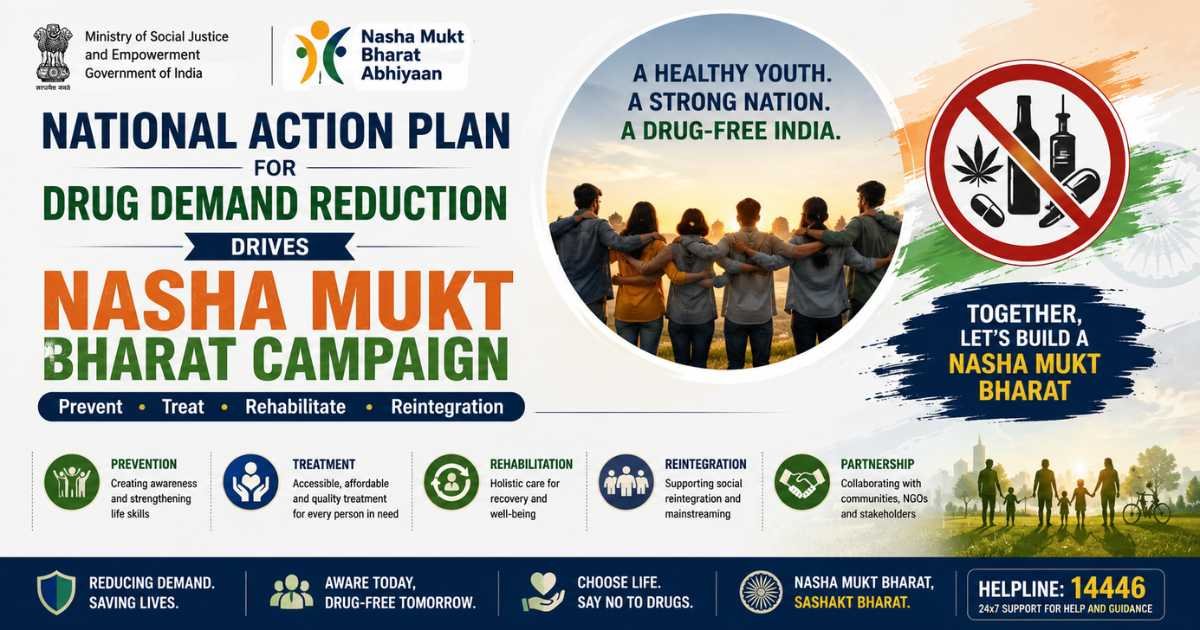
New Delhi: The Union Ministry of Social Justice and Empowerment said the Drug demand reduction strategy under the National Action Plan for Drug Demand Reduction (NAPDDR) and the Nasha Mukt Bharat Abhiyaan (NMBA) continued to expand treatment, rehabilitation and awareness programmes across the country.
Union Minister for Social Justice and Empowerment Dr. Virendra Kumar urged governments, civil society and citizens to work together to build a drug-free India. He said the Centre remained committed to tackling substance abuse through a whole-of-government and whole-of-society approach in line with Prime Minister Narendra Modi’s vision of a Nasha Mukt Bharat.
The Minister said the Ministry’s 2019 national survey found that more than seven crore people suffered from substance use disorders, including nearly 1.2 crore children and 58 lakh women. He added that awareness, empathy and coordinated action remained essential to address the challenge.
Secretary Sudhansh Pant said the Ministry expanded treatment and rehabilitation services through 768 de-addiction centres across the country. He said the number of people seeking treatment increased by 294%, rising from 2.08 lakh in 2020 to more than 8.20 lakh in 2025.
Drug demand reduction expands treatment and awareness
Pant said the Ministry’s toll-free de-addiction helpline 14446 received more than 4.69 lakh calls from individuals and families seeking support. Meanwhile, the NMBA App 2.0 improved monitoring by enabling States and other stakeholders to upload field activities with real-time visibility.
He urged citizens to join the campaign by registering as Nasha Mukti Mitr and taking the online pledge to support a drug-free society. Furthermore, he called on educational institutions, youth groups and community organisations to strengthen public participation.
The Ministry said Nasha Mukt Bharat Saptah, observed from June 17 to June 26 at Dev Sanskriti Vishwavidyalaya in Haridwar, engaged more than 1.31 crore people. The campaign featured rallies, seminars, training sessions, street plays, yoga programmes, essay and painting competitions, e-pledges and community outreach activities.
Representatives from States, Union Territories, government departments, treatment facilities and partner organisations also participated. They reaffirmed their commitment to strengthening prevention, rehabilitation and community engagement under the national campaign.
