

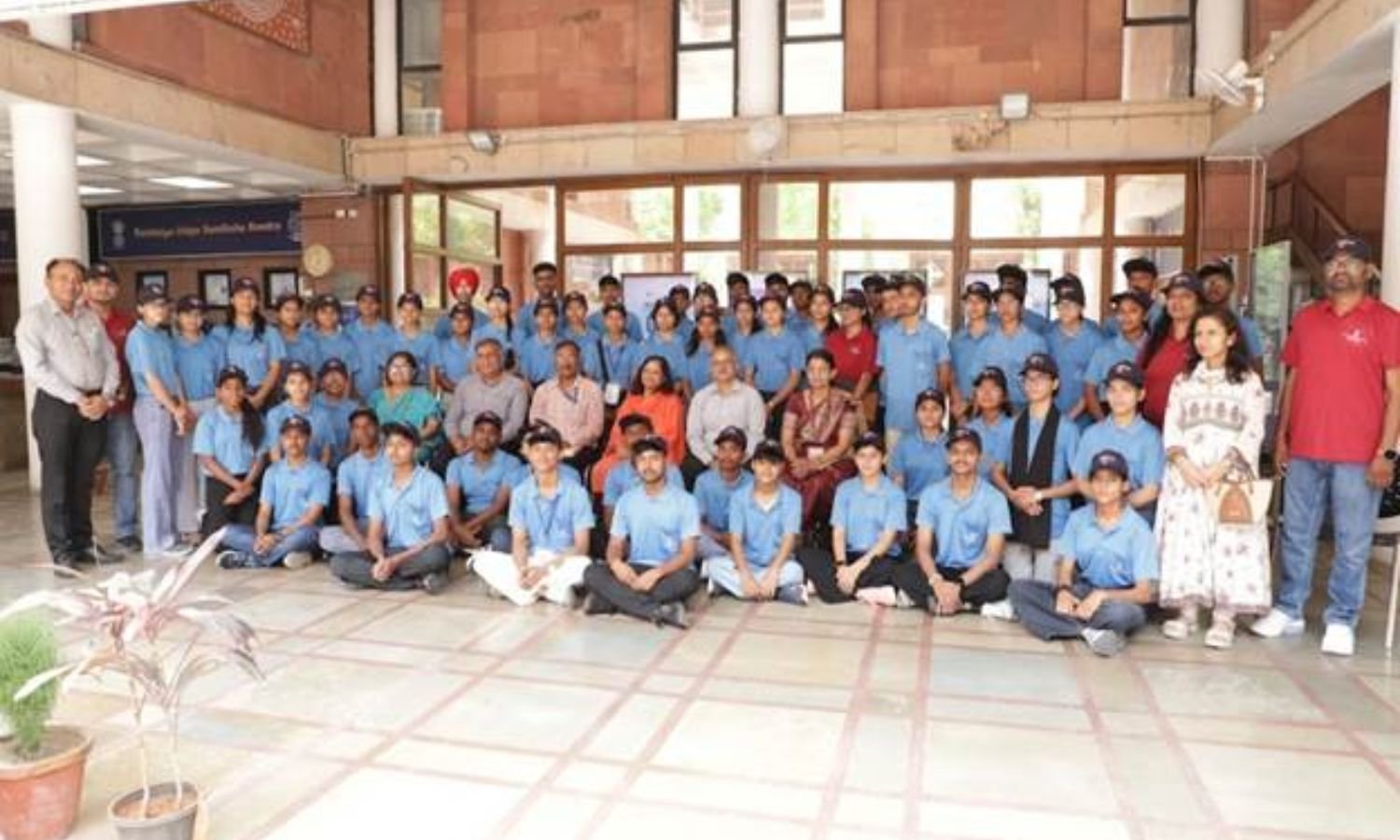
Hyderabad: The Department of School Education and Literacy under the Ministry of Education on Friday flagged off a group of Indian students participating in the Sakura Science Programme 2026 during a ceremony held at NCERT in New Delhi.
A total of 56 students and four supervisors will visit Japan from May 24 to May 30, 2026, under the Sakura Science Programme. The delegation includes 24 boys and 32 girls from government schools across 15 States and Union Territories. The participating students are beneficiaries of the National Means cum Merit Scholarship (NMMS) Scheme of the Government of India.
The students are from Assam, Dadra and Nagar Haveli and Daman and Diu, Goa, Gujarat, Haryana, Jharkhand, Karnataka, Madhya Pradesh, Maharashtra, Odisha, Punjab, Rajasthan, Tamil Nadu, Telangana, and West Bengal. Students from Ghana, Nigeria, and South Africa will also participate in the programme.
The flag-off ceremony was attended by Additional Secretary of the Department of School Education and Literacy Archana Sharma Awasthi, NCERT Director Prof. Dinesh Prasad Saklani, and Economic Advisor A. Srija.
Sakura Science Programme promotes global scientific exposure
The Japan Science and Technology Agency has been implementing the Sakura Science Programme since 2014 to encourage scientific exploration and cultural exchange among young learners in Asia and other regions. India joined the programme in April 2016.
Under the initiative, students visit Japan for one week to gain exposure to the country’s advanced science and technology ecosystem along with its cultural heritage. According to the Ministry of Education, 674 students and 96 supervisors from India have participated in the programme so far. The previous batch visited Japan in August 2025.
The Ministry stated that the National Education Policy 2020 encourages experiential and holistic learning across all stages of education. It added that educational visits and exposure trips to scientific, cultural, and technological institutions help students expand their intellectual and practical understanding.
The Ministry noted that Japan offers valuable opportunities for students to learn about innovation, scientific practices, and global collaboration through direct interaction with advanced educational and technological systems.
