

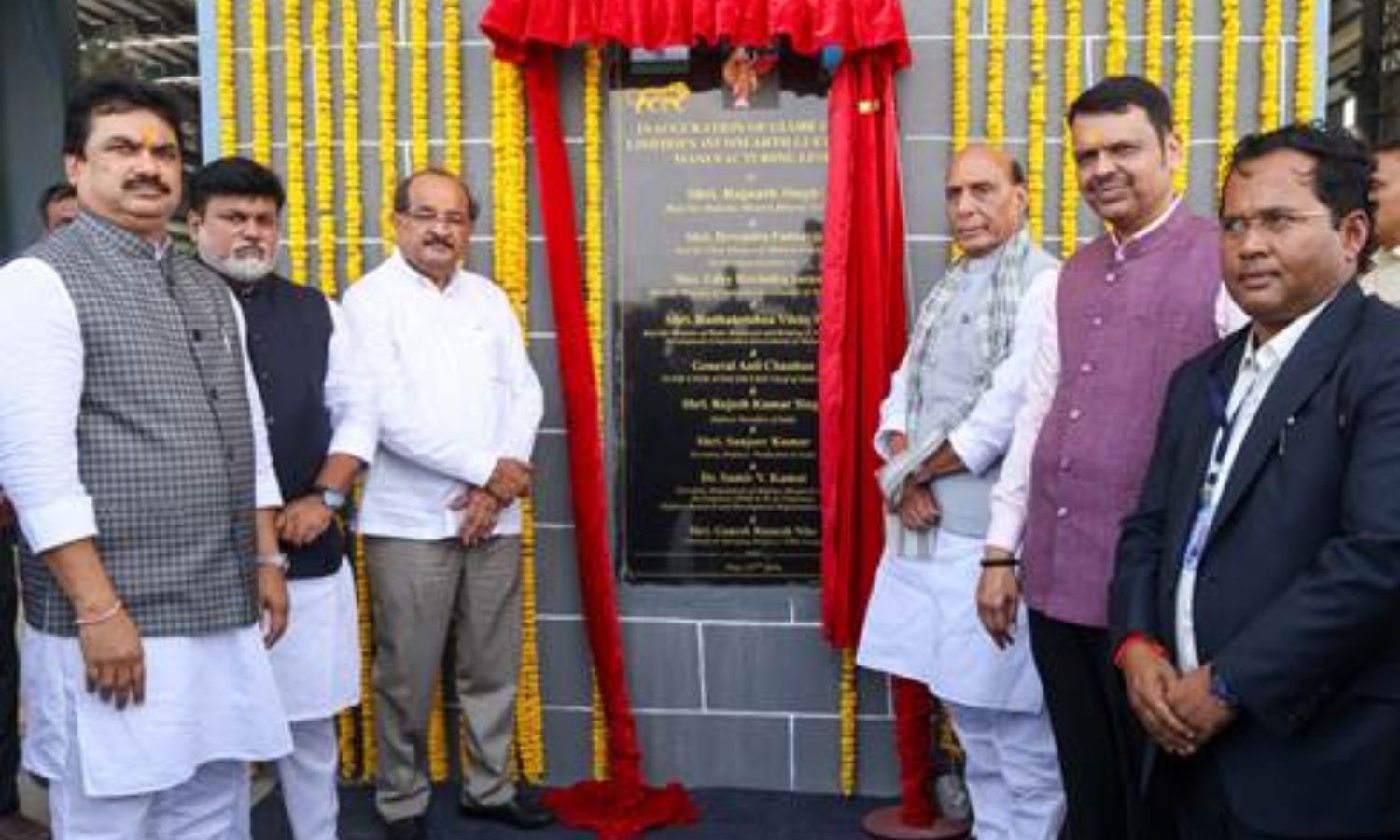
New Delhi: Raksha Mantri Rajnath Singh on Friday inaugurated a defence manufacturing complex developed by private sector firm NIBE Group in Shirdi and flagged off India’s first 300 KM Universal Rocket Launching System, ‘Suryastra’. He said a nation capable of manufacturing its own weaponry shapes its own future and stressed that India must become self-reliant in defence production.
The defence manufacturing complex will produce advanced artillery systems, missile and space technologies, rocket systems, energetic materials, and autonomous defence platforms. During the event, the foundation stone was laid for a missile complex linked to the Suryastra system. Indigenous TNT Plant Technology, RDX Plant Technology, and a Renewable Bio-Energy Compressed Biogas Plant were also unveiled.
Rajnath Singh said future wars would depend more on advancements in munitions and automation than on the size of military forces. He referred to the Russia-Ukraine conflict, tensions in West Asia, and Operation Sindoor as examples of how modern warfare is changing. He added that India’s private defence industry understands these challenges and is working to build advanced systems for the armed forces.
The Raksha Mantri said the Centre had opened defence manufacturing to the private sector after recognising its industrial capabilities. He added that the government was ready to take every necessary step to transform India into a global hub for munitions and automated systems.
Defence manufacturing complex to boost indigenous capability
Rajnath Singh said self-reliance in defence production was necessary not only for war preparedness but also for economic resilience and long-term peace. He stated that India could not depend on foreign countries for critical military requirements when trade, supply chains, and rare earth minerals were increasingly being weaponised globally.
He highlighted policy measures introduced by the Ministry of Defence over the last decade, including liberalised FDI norms, the Strategic Partnership Model, Positive Indigenisation Lists, and innovation schemes such as iDEX, ADITI, and the Technology Development Fund. According to him, the private sector’s contribution to defence production has increased to nearly 25-30 per cent and the government aims to raise it to 50 per cent in the coming years.
The Raksha Mantri said the defence manufacturing complex would support MSMEs, local suppliers, and ancillary industries while creating employment opportunities for youth with advanced technological skills. He added that the indigenous Suryastra rocket system would significantly enhance India’s strike capability and strengthen future warfare preparedness.
Maharashtra Chief Minister Devendra Fadnavis praised the Centre’s Aatmanirbhar Bharat and Make-in-India initiatives. He said India’s defence ecosystem had strengthened through equal participation from public and private sectors. The event also included technology demonstrations, MSME defence capability displays, and interactions with industry leaders and defence stakeholders.
