

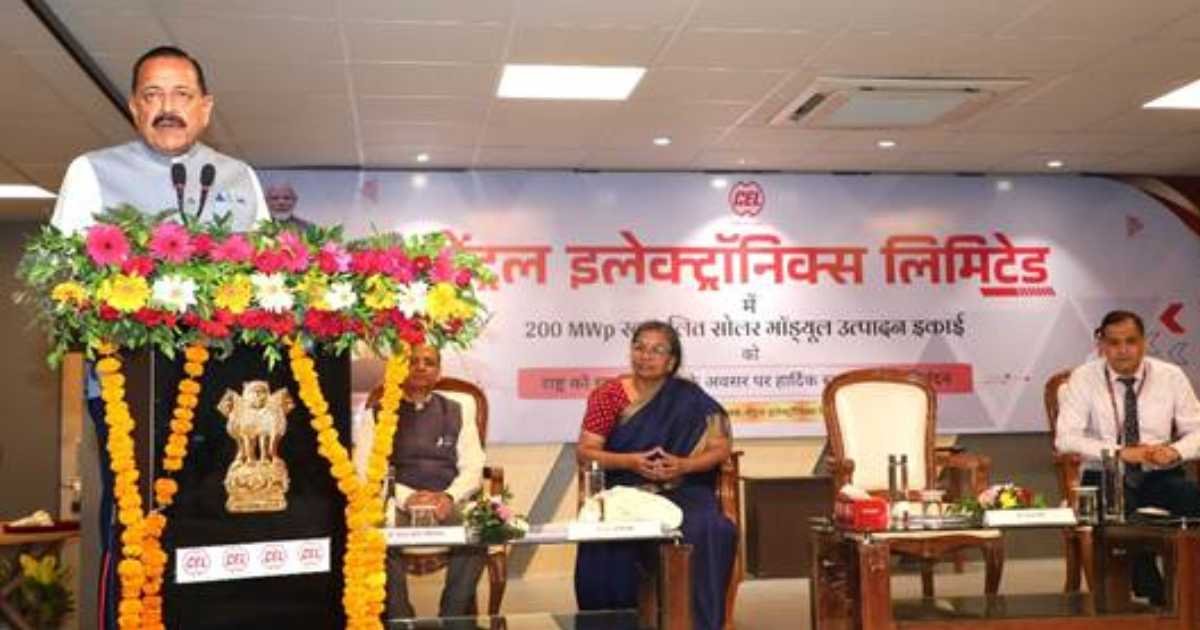
New Delhi: Union Minister of State (Independent Charge) Dr. Jitendra Singh dedicated the 200 MW solar module manufacturing line of Central Electronics Limited (CEL) to the nation on Wednesday. He stated that renewable and clean energy would play a major role in India’s growth under Prime Minister Narendra Modi’s leadership.
The Minister said India aimed to achieve net-zero emissions by 2070. Moreover, he noted that the country was expanding capacity across solar, wind, nuclear, and ocean-based energy systems. He added that an integrated approach would guide clean energy development.
Senior officials, scientists, and representatives from CEL and CSIR attended the event. In addition, technology collaboration initiatives between CSIR laboratories and CEL were highlighted during the programme. These efforts focus on renewable energy systems and indigenous innovation.
Dr. Singh described the operationalisation of the 200 MW facility as a major milestone. Therefore, he said it strengthened India’s clean energy ecosystem and manufacturing capabilities. He also emphasized that indigenous production supports national self-reliance.
Solar module manufacturing milestone and institutional revival
The Minister recalled CEL’s historic contribution to India’s renewable energy journey. For instance, he noted that the company manufactured India’s first solar cell in 1977. Furthermore, he mentioned that India’s first solar plant was established by CEL in 1979.
He said the institution had undergone significant transformation. Consequently, CEL evolved from a company once facing challenges into a profit-making Mini Ratna enterprise. He credited policy support, leadership, and workforce commitment for this turnaround.
The Minister also appreciated the rapid execution of the project. The Request for Proposal was issued on 24 April 2025. Subsequently, the bidder was selected within one month. The manufacturing line became operational in less than a year.
Additionally, Dr. Singh said CEL was expanding into advanced sectors such as renewable systems, defence electronics, and strategic technologies. He highlighted reforms that opened space and nuclear sectors to wider participation. Therefore, he said these initiatives reflected growing technological confidence.
Technology transfer efforts were also welcomed during the event. In particular, collaborations involving the Automated Weather Observing System and the new-generation Drishti Transmissometer System were noted. Moreover, the Minister said indigenous technologies should move toward wider use through industry partnerships.
He concluded that the dedication of the solar module manufacturing line marked another step toward Viksit Bharat 2047. In his view, the initiative demonstrated how scientific capability can support national development goals.
