

New Delhi: The National Institute of Tuberculosis and Respiratory Diseases (NITRD) was officially recognised as a Zero Waste to Landfill facility under Swachh Bharat Mission Urban 2.0, setting a benchmark for sustainable waste management in India’s healthcare sector.
The Municipal Corporation of Delhi acknowledged the achievement, which was implemented by the Why Waste Wednesdays Foundation under its Swachh Sankalp programme. The initiative demonstrated that structured planning and collective action can transform waste management systems in large institutions.
Spread across 27 acres, NITRD generated nearly 1 to 1.2 tonnes of waste daily, including 500–650 kg of wet waste. Despite the scale, the institute achieved full compliance under the Bulk Waste Generator category as per the 2026 Solid Waste Management Guidelines. This marked it as a leading healthcare facility adopting sustainable practices.
The project began with a detailed waste audit and baseline survey. It mapped waste streams and identified gaps in existing systems. Based on these findings, the team designed targeted interventions. Subsequently, nearly 50 training sessions were conducted for staff and administrators. These sessions improved awareness of segregation, recycling, and composting practices.
As a result, the programme ensured participation across all levels. It also triggered behavioural changes and strengthened accountability in waste handling.
NITRD zero waste infrastructure ensures full waste processing
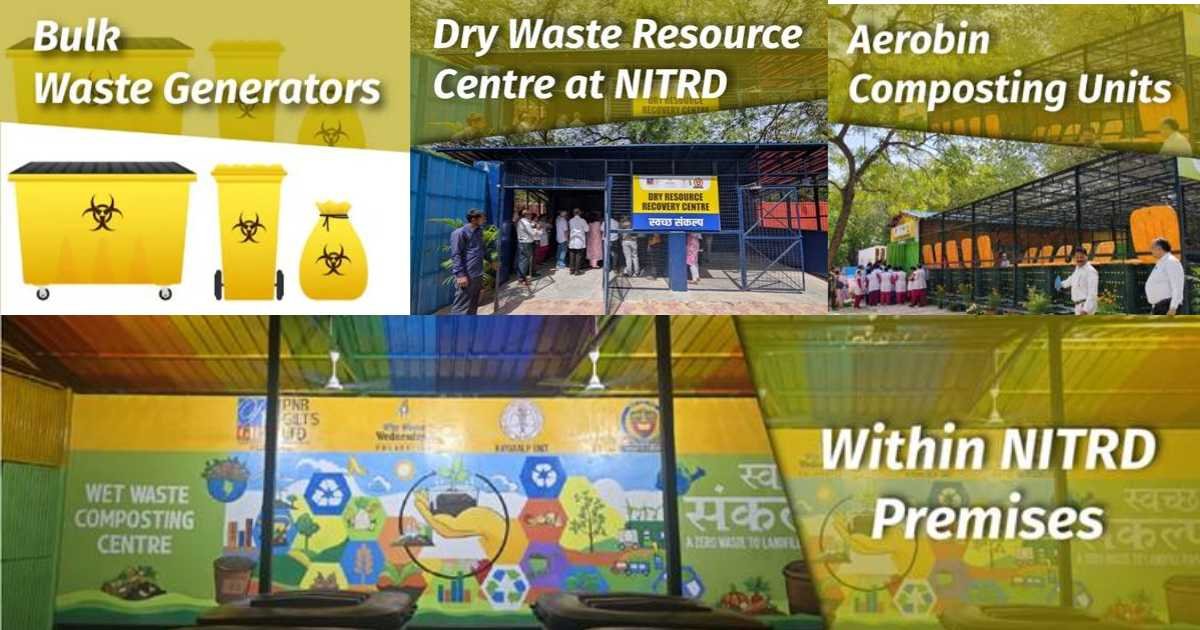
To support the initiative, authorities built a comprehensive waste management system on campus. A wet waste composting centre was established to process biodegradable waste. In parallel, a dry waste resource centre handled sorting and recycling operations efficiently.
Additionally, dedicated systems managed horticulture waste generated from landscaping. The institute installed 40 Gaia composting bins across the campus. Two shredders were also deployed to process large green waste materials.
Moreover, a monitoring station was set up for real-time oversight. A consumables management space ensured efficient resource tracking. Together, these systems created an integrated and sustainable waste ecosystem.
The South Zone team of the Municipal Corporation of Delhi inaugurated 40 Aerobin composting units at the Mehrauli facility. This strengthened the institute’s waste processing capacity further.
Officials said the initiative showed that large healthcare institutions can adopt zero-waste practices without affecting efficiency or patient care. It also provided a replicable model for hospitals across the country.
The NITRD zero waste initiative highlighted how institutional commitment and structured execution can drive sustainable urban development. It is expected to inspire similar efforts in the healthcare sector nationwide.
