

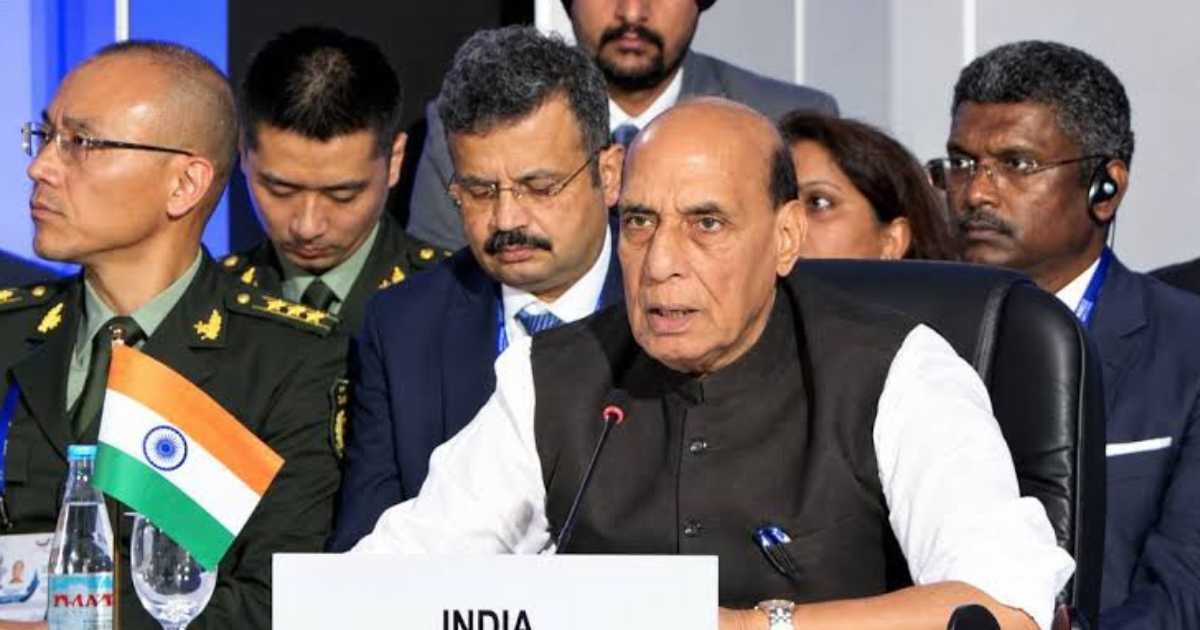
New Delhi: Defence Minister Rajnath Singh called for stronger counter-terrorism cooperation with ASEAN partners at the 13th ASEAN Defence Ministers’ Meeting-Plus (ADMM-Plus) in Cebu, Philippines, on October 29. He reaffirmed India’s commitment to regional security and offered to share the country’s operational expertise through joint exercises, intelligence sharing and capacity-building programmes.
Singh said India had developed its counter-terrorism capabilities over decades of confronting complex cross-border security challenges. For instance, he cited Operation Sindoor as an example of India’s proactive military doctrine. According to him, the operation demonstrated India’s resolve against state-sponsored terrorism.
The minister stressed that terrorism crosses national boundaries. Therefore, India stands ready to share its operational experience with partner countries. He identified counter-terrorism cooperation as a key priority under the ADMM-Plus framework.
India and Malaysia are co-chairing the Experts’ Working Group on Counter-Terrorism for the 2024–2027 cycle. Through this partnership, both countries aim to strengthen collaboration among participating nations. They also seek to improve their collective response to security threats.
Counter-terrorism cooperation supports wider ASEAN security goals
Singh reiterated India’s support for ASEAN centrality and a secure, open and inclusive Indo-Pacific. He said India’s engagement with ASEAN rests on shared interests, mutual respect and practical cooperation. In addition, he recalled the second ASEAN-India Defence Ministers’ Informal Meeting in Kuala Lumpur in October 2025. That meeting reaffirmed defence and security cooperation under the comprehensive strategic partnership.
Referring to the ADMM-Plus theme, “Navigating Our Future, Together,” Singh stressed solidarity and collective responsibility. He linked these principles to India’s foreign and defence policy. He also invoked the civilisational ethos of Sarve Bhavantu Sukhinah, meaning “May all beings be happy.”
The minister highlighted maritime cooperation as a priority for India and ASEAN in 2026. In this context, he noted that 2026 had been designated the ASEAN-India Year of Maritime Cooperation. He also pointed to the second ASEAN-India Maritime Exercise.
Singh said India remained committed to freedom of navigation and protecting global sea lanes. Moreover, he noted that the Indian Navy had maintained an active presence in volatile corridors, including the Gulf of Aden, since 2008. Indian warships had escorted thousands of merchant vessels and thwarted dozens of hijackings on the high seas, he added.
Furthermore, Singh described commercial shipping security as a shared responsibility. He said India would continue to serve as a reliable net security provider in the Indian Ocean Region and the wider Indo-Pacific. He also emphasised compliance with the United Nations Convention on the Law of the Sea.
The minister clarified that India’s position on maritime law, freedom of navigation and overflight does not target any country. Instead, these principles protect the common interests of regional stakeholders. Consequently, open sea lanes and stable maritime governance remain vital to the region.
Singh also called for stronger cooperation in maritime safety, search and rescue, humanitarian assistance and capacity building. Accordingly, India remained ready to work with ASEAN partners in these areas.
He proposed a dedicated defence “Youth Bridge” to deepen ties between India and ASEAN. The initiative would strengthen institutional links, promote digital innovation and expand capacity building. In addition, Singh said greater youth participation would support regional peace, security and prosperity. He linked the proposal to the “Youth, Peace and Security” agenda.
