

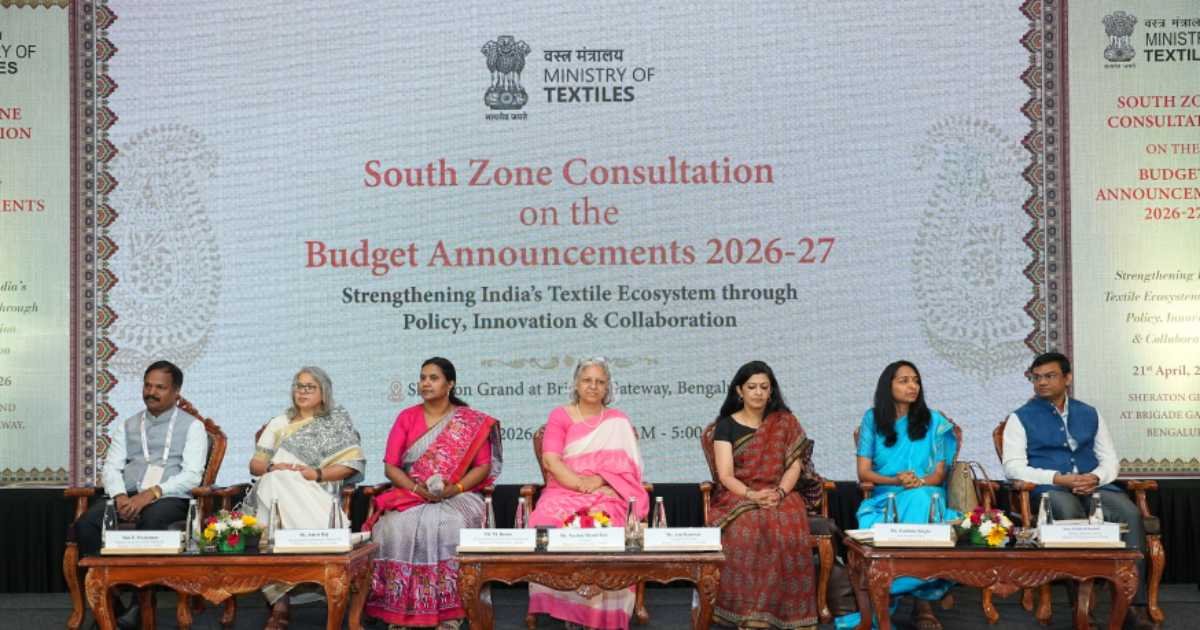
New Delhi: Textile schemes workshop brought together key stakeholders in Bengaluru to discuss new initiatives announced in the Union Budget 2026–27.
The Ministry of Textiles organised the South Zone consultation with officials, state representatives and industry participants. During the session, stakeholders reviewed policy measures aimed at strengthening the textile sector.
Moreover, Secretary Neelam Shami Rao said the sector will play a crucial role in achieving India’s 2047 development vision. She stressed the need to improve both quality and scale across the value chain. In addition, she highlighted the importance of modernisation, circularity and adapting to changing consumer preferences.
Furthermore, she called for better use of textile waste, including both pre-consumer and post-consumer materials. This, she noted, would support sustainability and efficiency in the industry.
Textile schemes workshop focuses on growth and employment
Officials said the new schemes aim to provide integrated support across the sector. Development Commissioner Dr M. Beena stated that artisans and weavers would benefit significantly from these initiatives.
In addition, Joint Secretary Padmini Singla addressed concerns raised by state departments. She also outlined practical solutions to improve implementation and overcome challenges.
Meanwhile, Additional Secretary Arti Kanwar explained various incentives under the schemes. These include subsidies for modernisation, wage support and employment-linked incentives. She also highlighted plans to promote indigenous machinery and expand textile infrastructure.
Therefore, the government aims to strengthen cluster development and encourage innovation. Plans for plug-and-play textile parks and Textile Seva Kendras will further support industry growth.
Additionally, officials discussed skill development under Samarth 2.0. The programme focuses on training through modern methods, mobile technology and industry-relevant courses. It also offers dual certification to improve employment opportunities.
At the same time, representatives stressed the need for a stakeholder-centric approach. They aligned the initiatives with the vision of “Farm to Foreign,” aiming to strengthen the entire value chain.
Thus, the textile schemes workshop highlighted a comprehensive strategy to boost employment, sustainability and global competitiveness in the sector.
