

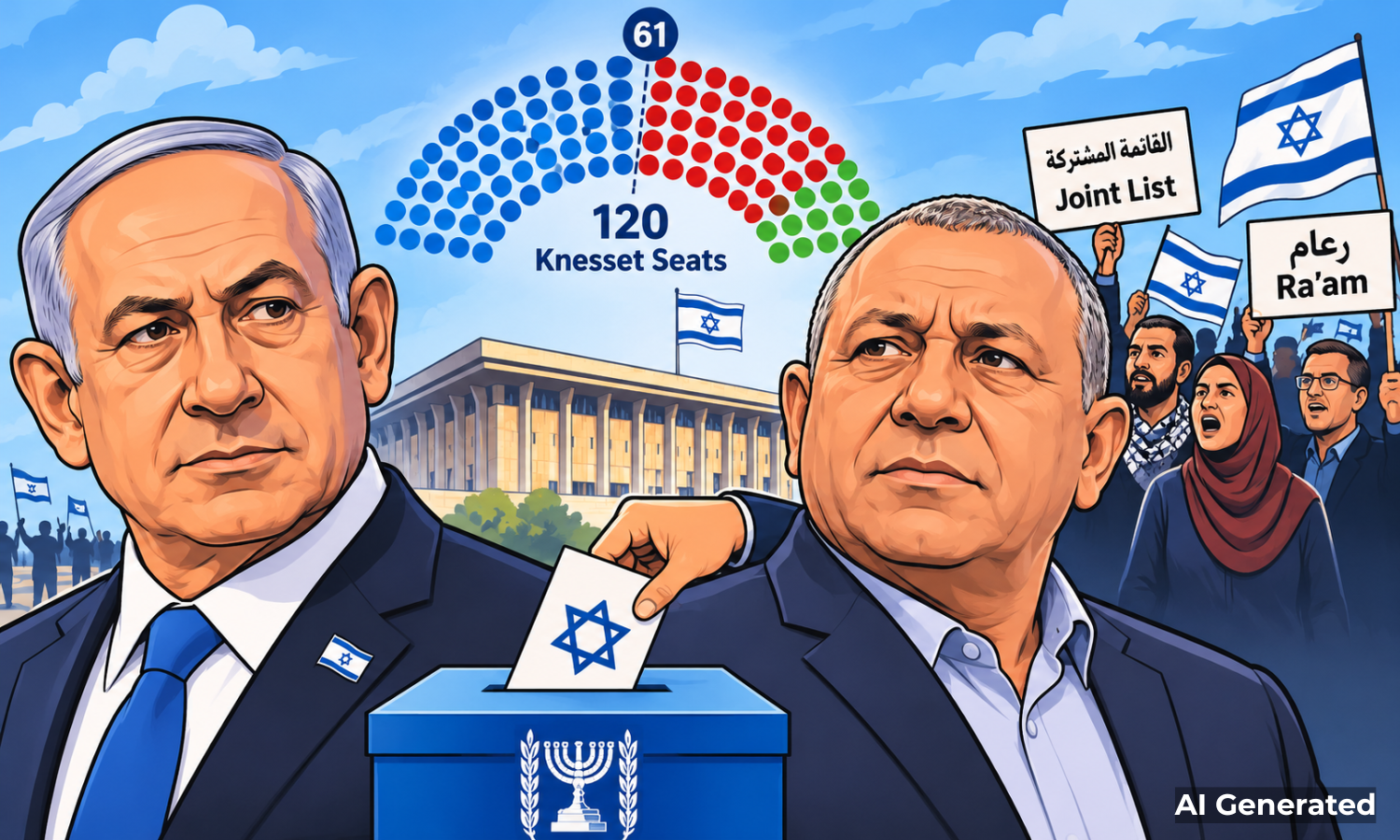
Jerusalem: Israel election results have left Prime Minister Benjamin Netanyahu and his opponents without a parliamentary majority, placing Arab parties in a potentially decisive position. The October 27 vote gave Netanyahu’s bloc 53 seats, while the opposition led by former army chief Gadi Eisenkot secured 48. Two Arab-led parties won a record 19 seats.
A government needs at least 61 seats in the 120-member Knesset. The Central Elections Committee completed the vote count on October 30 and will formally present the results to President Isaac Herzog on November 4. Herzog will then begin consultations with party leaders on forming the next government.
Voter turnout reached 77.9 per cent, the highest since 1999, compared with 70.6 per cent in 2022. Netanyahu’s governing bloc suffered significant losses, falling from 68 seats in the outgoing Knesset to 53.
Netanyahu’s Likud remained the largest party with 27 seats. Eisenkot’s Yashar secured 21, followed by the Bennett-Lapid alliance with 12. The Democrats won eight seats, while Avigdor Lieberman’s Yisrael Beytenu secured seven.
Among Netanyahu’s allies, United Torah Judaism and Otzma Yehudit won seven seats each. Shas and Religious Zionism secured six each.
The Joint List, comprising Hadash, Ta’al and Balad, emerged with 11 seats. Mansour Abbas’s Ra’am won eight. Together, the Arab parties increased their representation from 10 to 19 seats, surpassing their previous record of 15 in 2020.
Israel election results put Arab parties at centre of coalition talks
The results have created a difficult political equation. Eisenkot’s 48-seat opposition bloc could reach 67 seats with support from both Arab parties. However, several opposition leaders ruled out formal cooperation with Arab parties during the election campaign.
Arab leaders have nevertheless indicated their willingness to help replace Netanyahu. Joint List leader Ahmad Tibi has expressed support for an Eisenkot-led minority government from outside the coalition. Ra’am leader Mansour Abbas has also warned against another Netanyahu government.
Meanwhile, Netanyahu’s camp has raised allegations of foreign interference and voting irregularities in Arab-majority areas. However, election authorities have rejected claims of systematic interference affecting the integrity of the vote.
The political deadlock could lead to prolonged negotiations. Netanyahu may seek support from parties outside his existing alliance, while Eisenkot must overcome opposition to cooperation with Arab representatives. Failure to form a government could eventually trigger another election.
For Palestinians, however, a change in government may not bring a major policy shift. Eisenkot opposes Palestinian statehood following the October 7, 2023 Hamas attacks. He also supports dismantling Hamas’s military capabilities but opposes formal annexation of the West Bank.
Both Netanyahu and Eisenkot consider Iran a major security threat, suggesting broad continuity in Israel’s regional security priorities.
India, meanwhile, is expected to maintain its strategic relationship with Israel regardless of the coalition outcome. Defence cooperation, trade and employment opportunities for Indian workers remain important areas of bilateral engagement.
The immediate focus will now shift to Herzog’s consultations and the willingness of rival parties to negotiate. With neither major bloc holding a majority, the Arab parties’ record representation could prove crucial in determining Israel’s next government.
