

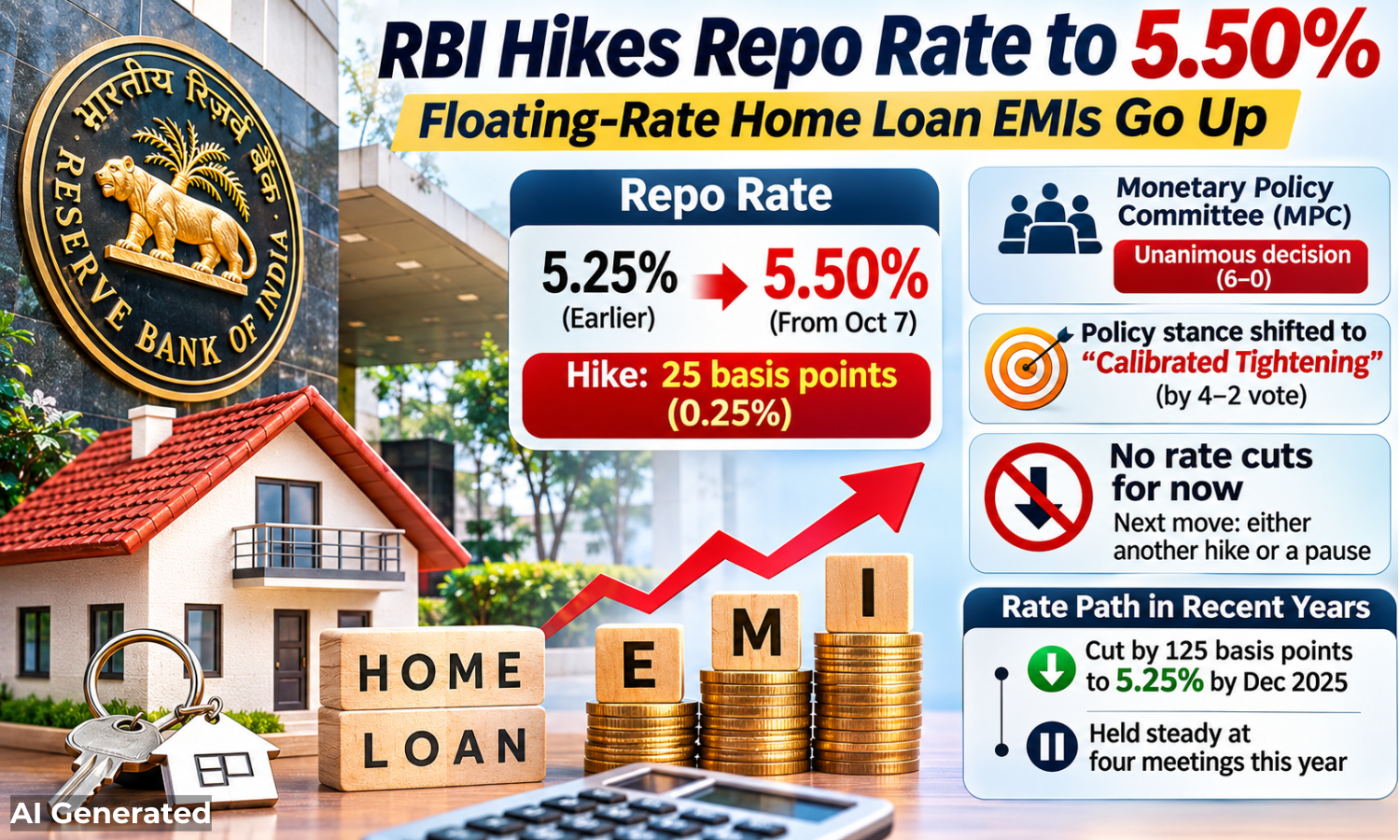
Mumbai: Home loan EMI payments are set to increase for floating-rate borrowers following the Reserve Bank of India’s first repo rate hike since February 2023. The Monetary Policy Committee (MPC) raised the benchmark rate by 25 basis points to 5.50 per cent on October 7, prompting banks to revise their lending rates.
The six-member committee unanimously approved the increase. It also voted 4-2 to change its monetary policy stance from neutral to calibrated tightening, signalling greater concern over inflation.
The decision marked a reversal of the RBI’s earlier easing cycle. The central bank had reduced the repo rate by 125 basis points to 5.25 per cent by December 2025. It subsequently maintained the rate at four consecutive policy meetings before announcing the October increase.
RBI Governor Sanjay Malhotra attributed the policy shift to growing inflationary pressures. The central bank raised its consumer inflation forecast for 2026-27 to 5.2 per cent, with inflation expected to reach 6 per cent during the October-December quarter.
Higher food prices, expensive crude oil and concerns over a weak monsoon contributed to the revised outlook. However, economic growth remained relatively strong, allowing the RBI to tighten monetary policy.
The central bank also increased its GDP growth forecast to 7.1 per cent from 6.7 per cent. The stronger growth projection suggested that the economy could absorb moderately higher borrowing costs.
How much will your home loan EMI increase?
Several banks revised their repo-linked lending rates within days of the RBI announcement. Punjab National Bank and Bank of India reportedly increased their rates from 8.10 to 8.35 per cent.
Similarly, Bank of Baroda revised its rate from 7.90 to 8.15 per cent, while Indian Bank raised it from 7.95 to 8.20 per cent. State Bank of India also announced revised lending rates effective October 15.
For borrowers, even a 25-basis-point increase can significantly affect long-term repayment costs.
Consider a Rs 50 lakh home loan with a repayment period of 20 years. At an interest rate of 8 per cent, the monthly EMI works out to approximately Rs 41,822.
If the interest rate increases to 8.25 per cent, the EMI rises to Rs 42,603. This represents an additional Rs 781 per month, or approximately Rs 9,375 annually.
The impact is smaller on shorter loans. For example, the EMI on a Rs 10 lakh car loan over five years increases by approximately Rs 120 per month following a similar rate revision.
However, the actual impact depends on the loan agreement. Banks may increase monthly instalments, extend repayment periods or adopt a combination of both. Borrowers with fixed-rate loans generally remain unaffected until their contractual reset dates.
Meanwhile, depositors have received relatively limited benefits from higher interest rates. ICICI Bank reportedly increased certain fixed deposit rates by around 10 basis points, offering 6.60 per cent on selected three-year deposits.
Bajaj Finance also revised some deposit rates upwards by 15 to 40 basis points. However, SBI and HDFC Bank had not announced broad-based deposit rate increases by late October.
Attention has now shifted to the RBI’s next monetary policy meeting, scheduled for December 2-4. Economists remain divided over whether the central bank will announce another increase or maintain the existing rate.
ICRA economist Aditi Nayar expects one additional rate hike, followed by a pause in 2027. SBI Research, however, has indicated the possibility of a larger 50-basis-point increase if inflationary pressures persist.
For existing borrowers, the immediate priority is to review their loan reset dates and repayment schedules. With borrowing costs rising, even modest rate changes could increase the financial burden on households carrying long-term debt.
