

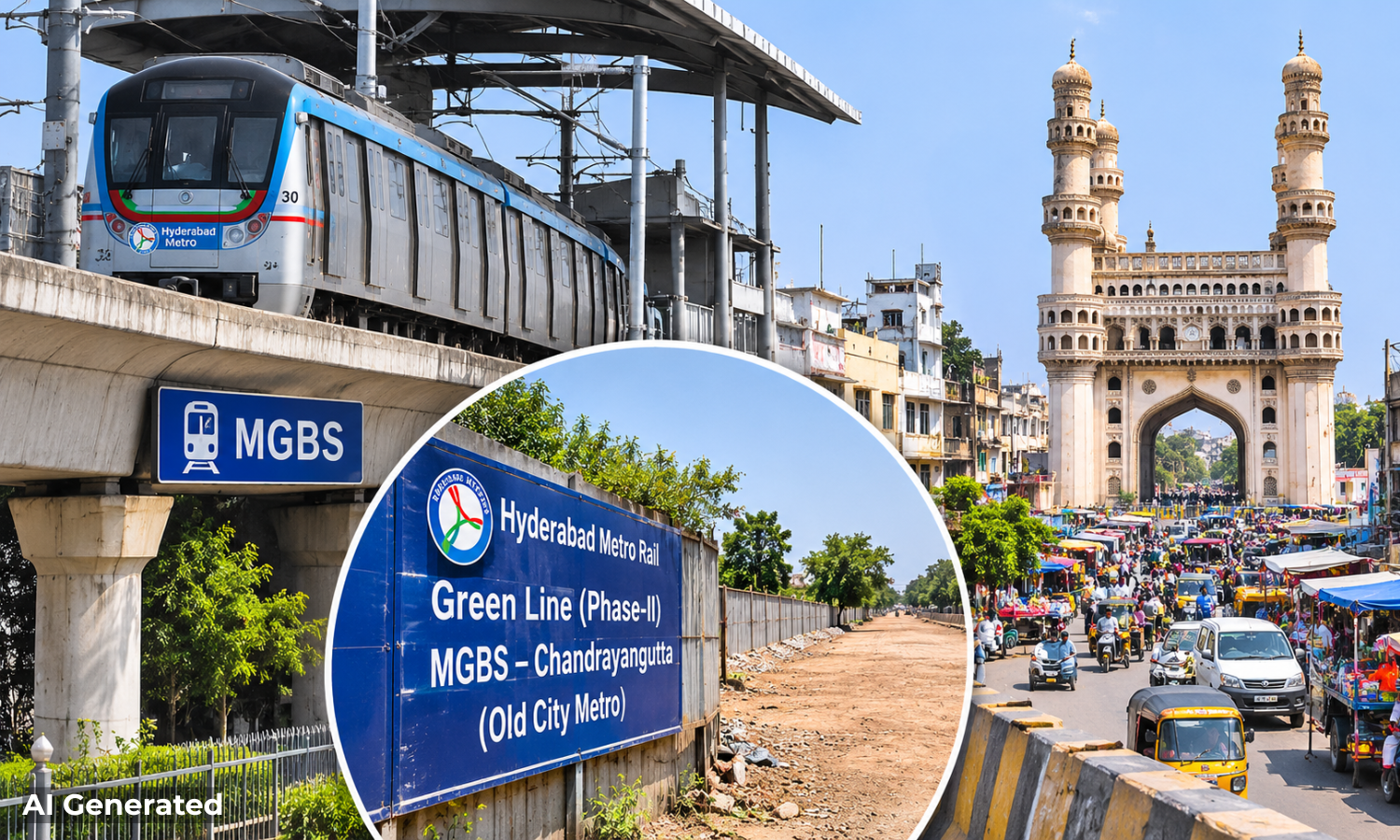
Hyderabad: The Old City Metro project remains stuck at the land acquisition stage despite reports that nearly 93 per cent of the required properties have been cleared. Although officials expect construction to begin in early 2027, the long-awaited corridor from MGBS to Chandrayangutta has yet to see its first pillar.
Reports in late October suggested that the Centre had approved Hyderabad Metro Phase II. However, no official order or Press Information Bureau (PIB) announcement has confirmed the clearance. The uncertainty has raised fresh questions about the project’s construction schedule.
By mid-October, authorities had reportedly acquired or demolished between 833 and 888 properties along the proposed 7.5-km corridor. Around 55 properties remain, including several linked to religious institutions and heritage structures.
Officials expect civil works tenders by early 2027. If the remaining approvals arrive on schedule, pillar construction could begin around January. However, the timeline remains tentative.
The proposed 76.4-km Phase II network carries an estimated cost of Rs 24,269 crore. A wider 122.9-km expansion plan, announced in June, has an estimated cost of Rs 38,595 crore. The government has targeted 2029 for completing Phase II, subject to necessary approvals.
Meanwhile, officials have proposed changes in pillar locations and spans to protect sensitive structures. Petitions seeking a heritage impact assessment remain pending before the Telangana High Court. The court lifted an earlier stay on land acquisition in August, allowing the process to continue.
Old City Metro remains unfinished after 14 years
The Old City Metro’s prolonged delay dates back to 2012, when the original Hyderabad Metro plan included a 5.5-km Green Line extension from MGBS to Falaknuma. L&T began work on the first phase in April that year. While the other corridors became operational by 2020, the Old City stretch remained incomplete.
Alignment disputes emerged during an all-party meeting in December 2014. Subsequently, political disagreements and concerns over religious and heritage structures complicated the project. Congress leaders also accused the All India Majlis-e-Ittehadul Muslimeen (AIMIM) of obstructing the proposed route.
The previous BRS government allocated Rs 500 crore for the corridor in its 2022-23 Budget. In July 2023, then Chief Minister K Chandrashekar Rao directed officials to proceed with construction. Although surveys followed, the project made little visible progress.
After the change in government, Chief Minister A Revanth Reddy laid the foundation stone at Falaknuma on March 8, 2024. AIMIM president Asaduddin Owaisi attended the ceremony, raising hopes that the long-pending project would finally move forward.
However, construction remained elusive. In June 2026, Owaisi reminded the Chief Minister of his commitment to complete the corridor before the 2028 Assembly elections. In September, Revanth Reddy said land acquisition was nearing completion.
The acquisition process has nevertheless recorded substantial progress. By April 2025, the government had paid Rs 212 crore in compensation for 205 properties. Further acquisitions and demolitions continued through 2026, bringing most of the proposed alignment under government control.
Despite this progress, the project still faces administrative, financial and construction-related hurdles. The absence of confirmed central approval also leaves uncertainty over the broader Phase II expansion.
For Old City residents, the delay means continued dependence on congested roads and existing public transport. The proposed corridor is expected to improve connectivity between the historic southern neighbourhoods and Hyderabad’s wider Metro network.
Fourteen years after the project was first proposed, land acquisition has moved considerably faster than construction. Until work begins on the first pillar, the Old City Metro will remain a long-awaited promise rather than an operational transport link.
