

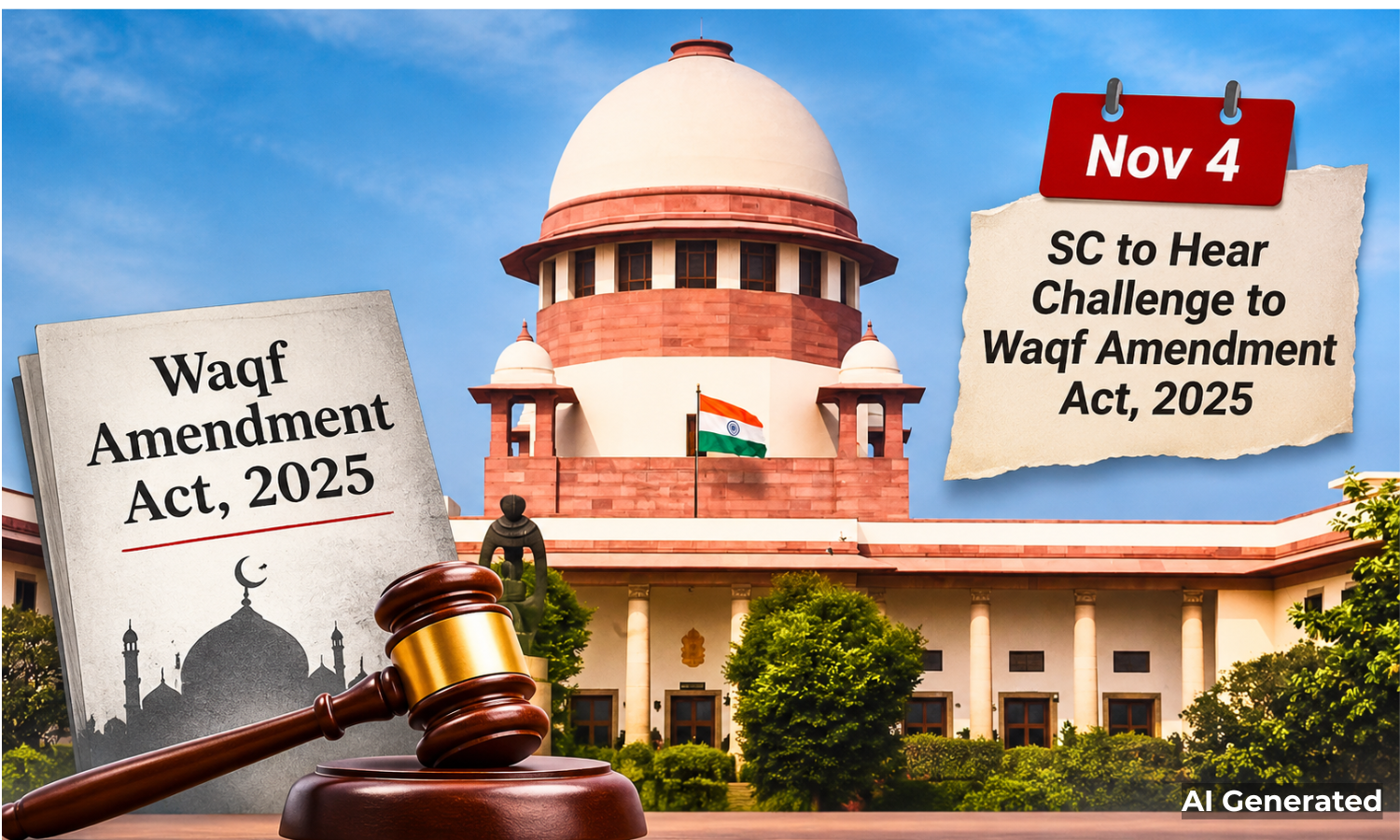
New Delhi: The Supreme Court will hear petitions challenging the Waqf Amendment Act, 2025, on Wednesday, November 4, amid growing concerns over the legal status of waqf properties. Petitioners have warned that changes to property records and ownership protections could become irreversible before the court delivers its final verdict.
A bench comprising Chief Justice Surya Kant and Justice Joymalya Bagchi scheduled the hearing on October 15. Senior advocate Nizamuddin Pasha, appearing for AIMIM president Asaduddin Owaisi, raised concerns over the changing status of waqf properties. The court subsequently listed the main petitions along with applications seeking further interim relief.
The hearing comes more than a year after the Supreme Court suspended certain provisions of the legislation. However, the court has yet to decide the constitutional validity of the Act.
On September 15, 2025, a bench headed by then Chief Justice B R Gavai declined to suspend the entire law. The court observed that parliamentary legislation carries a presumption of constitutionality. Nevertheless, it granted interim protection against several disputed provisions.
The court suspended the requirement that a person must practise Islam for five years before creating a waqf. It also restricted the power of government officers to determine whether disputed waqf properties belong to the government.
Furthermore, the court barred dispossession and the creation of third-party rights over properties facing government ownership inquiries until the Waqf Tribunal decides their status. It also imposed limits on non-Muslim representation in waqf administrative bodies.
The November 4 hearing could determine whether additional interim safeguards are necessary. However, a final judgment on the constitutional challenge is not necessarily expected at this stage.
Waqf Amendment Act hearing holds significance for Telangana
Telangana has a substantial stake in the proceedings because of its extensive waqf holdings and thousands of pending property disputes.
According to older Telangana State Waqf Board records, the State has 33,929 waqf institutions covering approximately 77,538 acres. Meanwhile, Union government data showed 63,788 property entries initiated on the UMEED portal by March 27, 2026. Of these, 52,656 had received approval.
The board also faces nearly 5,500 legal disputes. According to a recent consolidated account, these include 3,715 cases before the Telangana High Court, 1,549 before the Waqf Tribunal and 230 in other courts. Hyderabad accounts for 1,626 disputes, followed by Ranga Reddy with 1,315 and Medak with 299.
In a significant judgment on October 26, the Supreme Court restored a permanent injunction in favour of the Telangana Waqf Board over 16 acres and 5 guntas of land at Hameedullah Nagar in Ranga Reddy district.
The disputed land is associated with Qutub Shahi Mosque and forms part of a notified waqf property. A bench of Justices J B Pardiwala and K Vinod Chandran set aside an earlier Telangana High Court ruling and restored the trial court’s injunction.
The court examined historical survey records, revenue documents and a 1989 gazette notification before ruling in favour of the Waqf Board. However, the property dispute is separate from the constitutional challenge to the Waqf Amendment Act.
Meanwhile, the Union government has defended the amendments as necessary to improve transparency, administration and property records. It maintains that stronger verification mechanisms will help prevent misuse and protect legitimate waqf assets.
Petitioners disagree, arguing that several provisions threaten the legal status of existing waqf properties. They contend that administrative decisions could weaken property protections before courts resolve ownership disputes.
Congress leader Mohammed Ali Shabbir, AIMIM president Asaduddin Owaisi and the All India Muslim Personal Law Board have opposed the legislation. Both maintain that the interim relief remains inadequate and continue to challenge the disputed provisions.
The Supreme Court’s hearing will therefore be closely watched by waqf institutions and litigants across the country. For Telangana, the outcome could have significant implications for thousands of properties, pending disputes and the future administration of waqf assets.
