

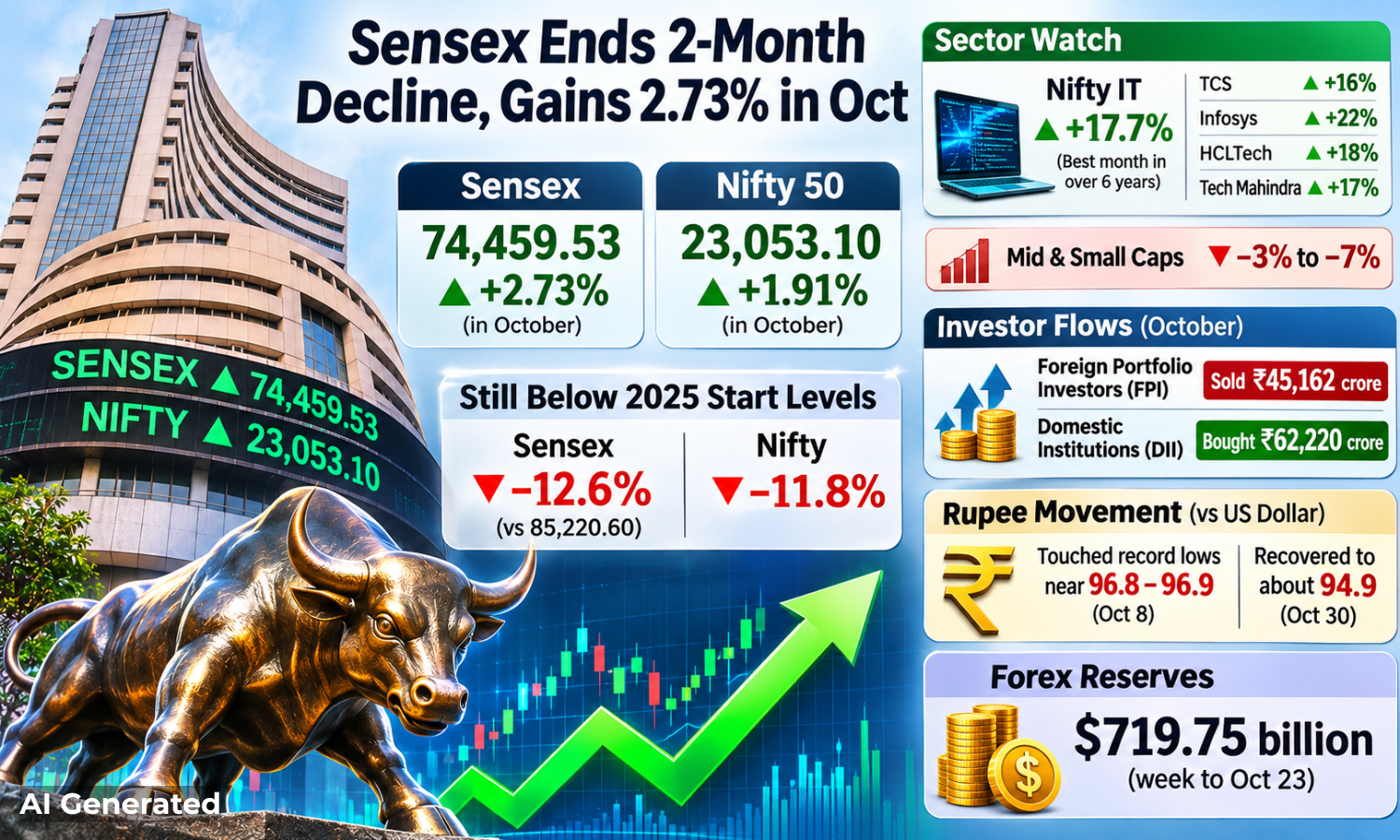
Mumbai: Indian stock markets ended October with their first monthly gains in three months, supported by a strong rally in information technology stocks. The Sensex rose 2.73 per cent to close at 74,459.53 on October 30, while the Nifty 50 gained 1.91 per cent to settle at 23,053.10.
The recovery ended two consecutive months of losses. However, both benchmark indices remained significantly below their levels at the beginning of 2026. The Sensex was down approximately 12.6 per cent from its 2025 closing level of 85,220.60, while the Nifty remained nearly 11.8 per cent lower.
Information technology stocks led the October rally. The Nifty IT index surged 17.7 per cent, recording its strongest monthly performance in more than six years. Major companies, including TCS, Infosys, HCLTech and Tech Mahindra, gained between 16 and 22 per cent.
However, the recovery remained concentrated in large technology stocks. Broader markets continued to struggle, with mid-cap and small-cap indices declining between 3 and 7 per cent during the month.
Foreign portfolio investors also maintained their selling pressure. Provisional National Stock Exchange data showed net foreign institutional selling of Rs 45,162 crore in October. Meanwhile, domestic institutional investors purchased shares worth Rs 62,220 crore, helping support benchmark indices.
Currency movements added to market volatility. The rupee weakened to record lows near Rs 96.9 against the US dollar in early October before recovering to approximately Rs 94.9 by October 30. India’s foreign exchange reserves stood at $719.75 billion for the week ended October 23.
Sensex in October gains despite high oil prices
Elevated crude oil prices remained a major concern for investors. India’s crude oil basket averaged $120.23 per barrel in October, compared with $116.09 in September. Supply disruptions around the Strait of Hormuz and attacks on Saudi infrastructure kept energy markets under pressure.
Higher oil prices increased concerns over inflation, import costs and corporate profitability. As India depends heavily on imported crude, sustained price increases could also weaken the rupee and widen the current account deficit.
Meanwhile, the Reserve Bank of India raised the repo rate by 25 basis points to 5.50 per cent on October 7. The decision followed a rise in retail inflation to 5.54 per cent in September.
Despite these pressures, several economic indicators remained positive. The HSBC flash composite Purchasing Managers’ Index rose to 56.7, its highest level in four months. The reading indicated continued expansion in manufacturing and services activity.
Gross Goods and Services Tax collections reached Rs 2.04 lakh crore in September, reflecting 14.7 per cent annual growth. However, passenger vehicle retail sales reportedly declined by approximately 21 per cent from a year earlier, highlighting uneven consumer demand.
Investors now face several important events in November. The US midterm elections on November 3 could influence global financial markets, while India’s October inflation figures are scheduled for release on November 12.
Second-quarter GDP data, expected towards the end of November, will provide further indications of economic growth. The RBI’s Monetary Policy Committee is scheduled to meet from December 2 to 4.
Market analysts believe a sustained recovery will depend on lower crude oil prices, currency stability and reduced foreign investor selling. A broader rally would also require stronger participation from banking, industrial and smaller companies.
For now, October’s gains have provided some relief after two difficult months. However, the sharp contrast between technology stocks and the broader market suggests that investor confidence remains selective.
