
India infrastructure development accelerates through transport, digital and energy expansion

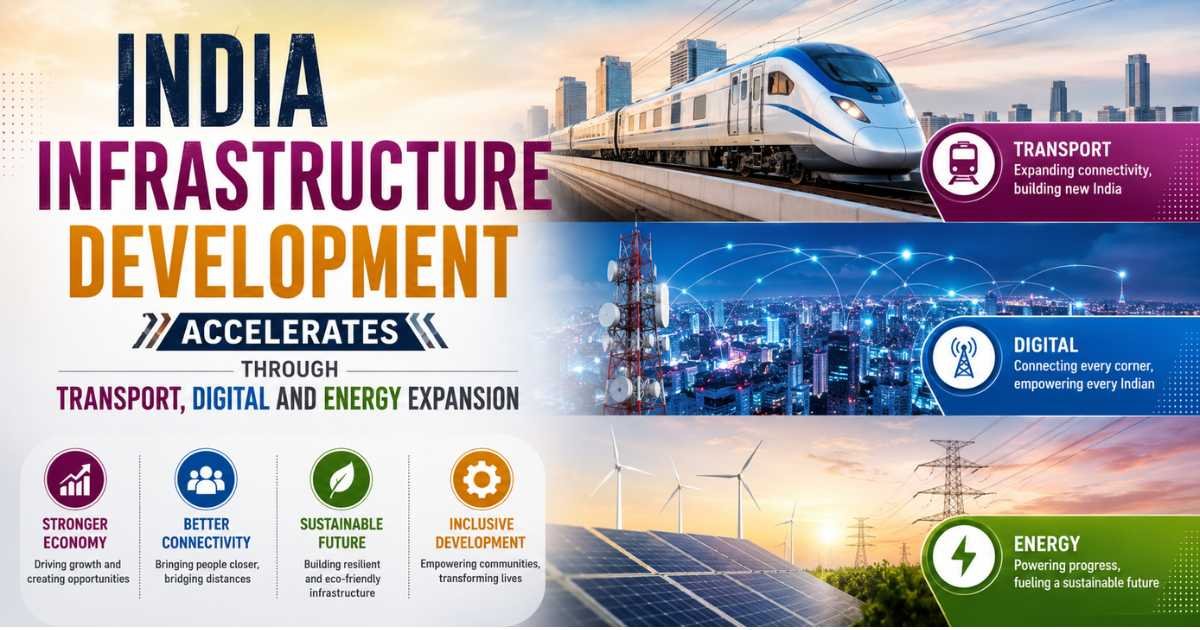
New Delhi: India infrastructure development witnessed rapid expansion over the past 12 years with major investments in transport, housing, energy, water, logistics and digital networks. The Centre said integrated planning and higher capital expenditure strengthened connectivity, improved services and supported economic activity.
Government initiatives including PM GatiShakti, National Logistics Policy, Sagarmala, Jal Jeevan Mission and UDAN helped create a connected infrastructure ecosystem. Public capital expenditure increased from around ₹2 lakh crore in FY2014–15 to ₹12.2 lakh crore in FY2026–27.
The railway sector recorded significant progress in electrification, station redevelopment and safety technology. Rail electrification reached 99.6 per cent of the network by March 2026. Vande Bharat trains expanded modern travel, while Kavach improved operational safety.
Road infrastructure also grew substantially. National Highways increased to 1.46 lakh km by March 2026. Four-lane highways and expressways expanded, improving freight movement and regional connectivity.
India infrastructure development strengthens national connectivity
Civil aviation witnessed major expansion as operational airports increased from 74 in 2014 to 165 in 2026. The UDAN scheme improved regional air access and connected smaller towns with major cities.
Metro networks expanded from 248 km in 2014 to over 1,155 km in 2026. Urban transport projects improved mobility and supported sustainable city development.
Ports and waterways also witnessed strong growth. Major port capacity nearly doubled, while inland waterways expanded from five to 111 National Waterways. These improvements enhanced trade efficiency and logistics performance.
Digital infrastructure transformed service delivery across India. Internet connections increased to more than 100 crore, while UPI became one of the world’s largest real-time payment systems. Digital platforms such as DigiLocker, UMANG and Common Service Centres improved citizen access to services.
The government also expanded water, housing and energy infrastructure. Jal Jeevan Mission provided tap water connections to over 15 crore rural households. PMAY schemes improved affordable housing access in urban and rural areas.
India strengthened its renewable energy capacity and achieved major progress in household electrification. Rooftop solar programmes, clean cooking initiatives and renewable energy expansion supported the transition towards sustainable growth.
The government stated that continued infrastructure investment would remain central to achieving the Viksit Bharat 2047 vision through stronger connectivity, improved services and increased economic opportunities.
