

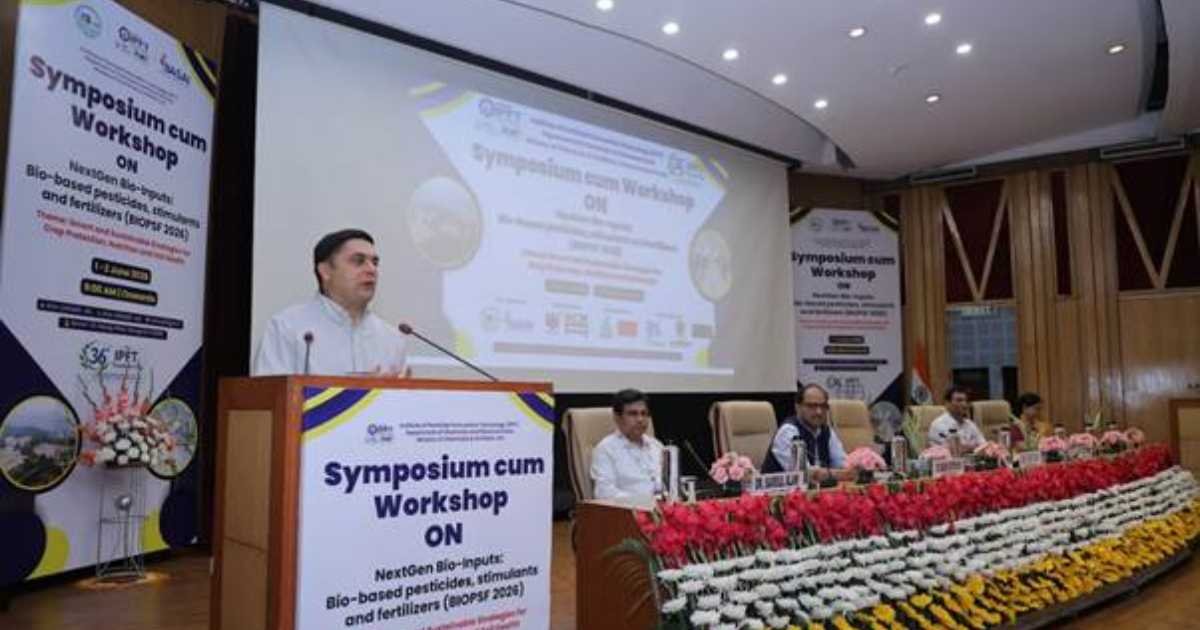
New Delhi: India has the potential to emerge as a global leader in the bio-based agri-input sector, driven by its strong scientific capabilities, rich biodiversity and expanding start-up ecosystem, Department of Chemicals and Petrochemicals Secretary Tejveer Singh said.
Addressing the valedictory session of BIOPSF 2026 in New Delhi, Singh said growing policy support for sustainable agriculture and targeted bio-economy initiatives would strengthen India’s position in the sector.
The two-day symposium-cum-workshop focused on “Next Gen Bio-Inputs – Bio-based Pesticides, Stimulants and Fertilizers.” The Institute of Pesticide Formulation Technology (IPFT), Gurugram, organised the event at the National Agricultural Science Complex.
Singh said scientific excellence, strong industry-academia collaboration and innovations from emerging entrepreneurs would help develop sustainable agricultural solutions. He added that these efforts would support India’s long-term agricultural and environmental goals.
The Secretary also highlighted the importance of formulation technologies in improving the effectiveness of bio-pesticides. According to him, better product stability, field performance and ease of application would increase farmer acceptance.
Bio-based agri-input sector supports Vikshit Bharat vision
Singh said India must strengthen indigenous technologies and promote translational research as it moves towards the vision of Vikshit Bharat 2047. He also stressed the need to encourage start-up-led innovation in bio-based chemicals, crop protection technologies and sustainable farm inputs.
Furthermore, he noted that a strong bio-economy would support sustainable growth while reducing dependence on conventional agricultural inputs.
BIOPSF 2026 formed part of the 36th Foundation Day celebrations of IPFT. The event brought together policymakers, scientists, regulators, industry representatives, entrepreneurs, researchers and students.
Participants discussed recent developments in bio-based agricultural inputs and explored ways to expand their role in sustainable farming. They also examined opportunities to strengthen research, innovation and commercial adoption across the sector.
