

New Delhi: Majuli climate study has reconstructed nearly 4,000 years of climate, vegetation and flood history on Assam’s Majuli Island, offering valuable insights that could help shape adaptation strategies for communities facing recurring floods and riverbank erosion.
Scientists from the Birbal Sahni Institute of Palaeosciences (BSIP), Lucknow, conducted the research on Majuli, the world’s largest inhabited river island. The island holds cultural significance as a centre of Neo-Vaishnavite traditions and as a home to several indigenous communities.
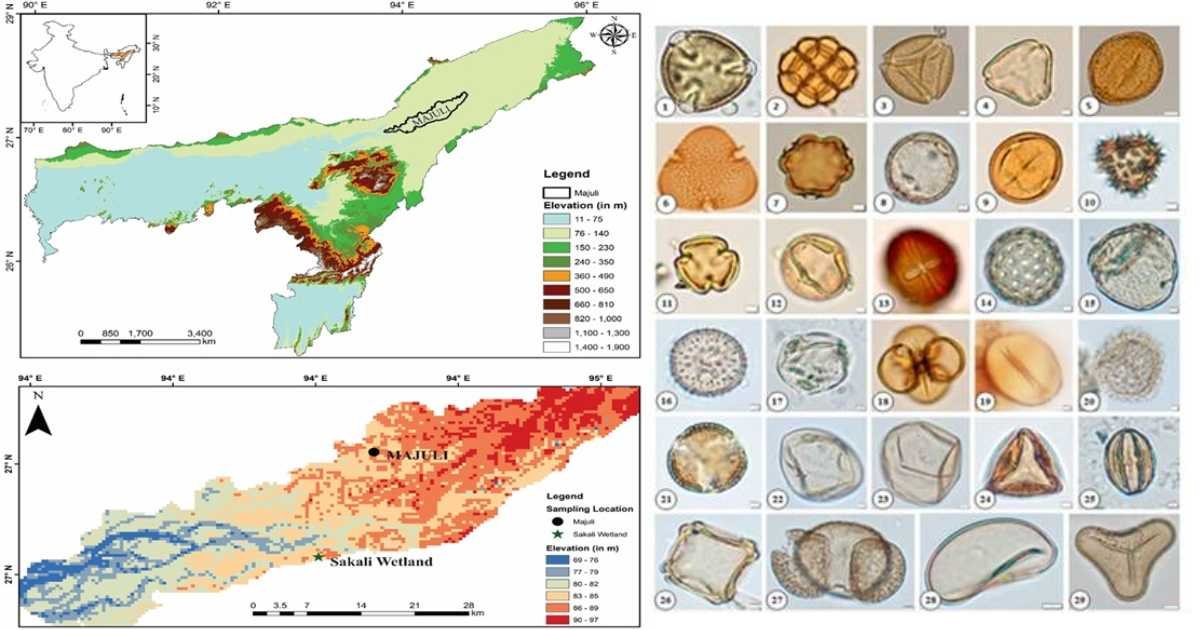
Researchers collected a 150-centimetre sediment core from the Sakali Wetland and combined pollen analysis with grain-size studies to create the first comprehensive environmental record for the island. The study examined climate and ecological changes between 4,040 and 500 calibrated years before present.
The findings revealed an early warm and humid phase between 4,040 and 2,260 years ago, when dense forests covered the region. Scientists noted that the ecosystem remained resilient during the global 4.2-kiloyear climatic event, a period associated with widespread drought in many parts of the world.
The research also documented changing monsoon patterns and flood regimes over centuries. A relatively moist phase occurred between 1,100 and 500 years ago, corresponding to the Medieval Climatic Anomaly. However, the past 500 years witnessed declining temperatures and rainfall, consistent with the Little Ice Age.
Majuli climate study highlights flood and erosion patterns
Researchers found that river dynamics played a crucial role in shaping the island’s environment. Grain-size analysis showed a gradual shift from low-energy to high-energy river conditions, indicating increasing hydrodynamic instability over time.
The study also demonstrated a close link between local vegetation changes and major global climatic events. Scientists said the findings improve understanding of flood intensity, sediment transport and erosion processes in the Brahmaputra basin.
In addition, the research identified periods of ecological resilience and vulnerability. These observations could support biodiversity conservation, wetland restoration and sustainable land-use planning in the region.
The team included researchers from BSIP, Banaras Hindu University and international collaborators. Published in the journal Review of Palaeobotany and Palynology, the study provides one of the most detailed reconstructions of climate-vegetation interactions on Majuli Island.
Scientists believe the findings can assist policymakers in designing climate adaptation measures and disaster mitigation strategies for communities affected by recurring floods, erosion and environmental change in the Brahmaputra Valley.
