

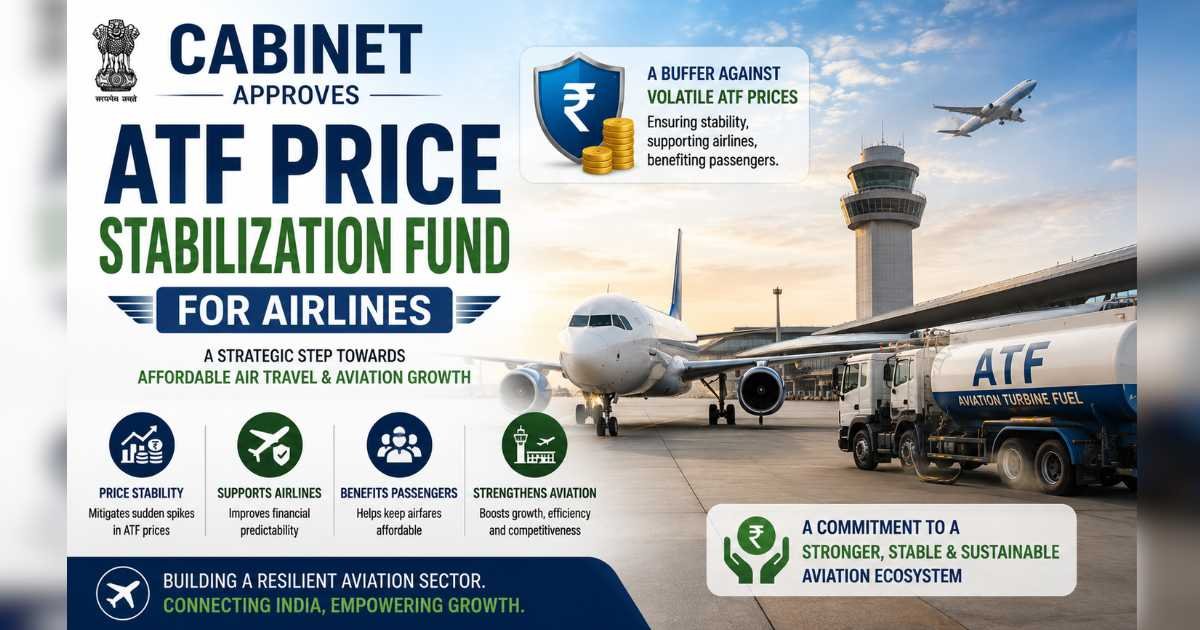
New Delhi: Union Cabinet has approved the ATF Price Stabilization Fund, providing one-time budgetary support of up to Rs. 10,000 crore to Oil Marketing Companies (OMCs) to help stabilise aviation turbine fuel prices for scheduled Indian airlines.
The decision aims to reduce the impact of sharp fuel price fluctuations caused by the ongoing West Asia crisis. Officials said the support would cover both domestic and international airline operations.
Under the approved mechanism, the government will provide interest-free advances to OMCs through the Ministry of Petroleum and Natural Gas. The fund will compensate OMCs when international ATF prices exceed the benchmark price fixed under the scheme.
The arrangement will remain in force for up to 36 months, subject to annual review. It may continue beyond that period if authorities require additional time to complete recovery and settlement.
The scheme will apply to all willing scheduled Indian airlines. In return, participating carriers will procure ATF exclusively from OMCs under agreements signed with the government and fuel suppliers.
ATF Price Stabilization Fund targets fuel cost volatility
The Cabinet said the mechanism would improve predictability in fuel costs and help airlines plan operations more effectively. It would also reduce exposure to sudden international fuel price spikes.
When global ATF prices decline, OMCs will return the differential amount to the Consolidated Fund of India through a recovery and true-up process. A monitoring committee comprising representatives from key ministries will oversee implementation, audits and settlements.
The government noted that ATF prices surged from Rs. 60.50 per litre in March 2026 to Rs. 142 per litre in May 2026 because of the West Asia crisis. Since fuel accounts for nearly 40 per cent of airline operating costs, the increase has placed significant pressure on airline finances.
Furthermore, the closure of Pakistan’s airspace for Indian carriers has increased flight times on several international routes, raising fuel consumption and operating expenses.
Officials said the fund would help maintain domestic and international air connectivity, moderate fare volatility and support regional air services. The measure is also expected to benefit tourism, hospitality, logistics, trade and airport infrastructure utilisation across the country.
